

Daily Support and Socialization: A Guide to Parkinson's Day Centers
How a Parkinson's Day Program Helps Your Parent Stay Connected
An adult day program for Parkinson's disease provides supervised activities, social time, and help with daily routines while your parent continues to live at home. To find a good fit in Utah Valley, ask each center how its staff supports walking, rest breaks, and medication schedules. Services vary, so a tour can help you see how the day would work for your parent.
Parkinson's can make everyday tasks harder and leave a parent spending more time alone. A day program can offer a steady routine and company while giving family caregivers time to work, run errands, or rest.
What Is a Parkinson's Disease Adult Day Program?
An adult day program is a structured, community-based setting designed to provide daytime care, social stimulation, and physical engagement for seniors living with chronic health conditions. Choosing dedicated adult day services allows older adults to spend their days in an active, supportive environment while continuing to sleep in the comfort of their own beds at night.
For someone living with Parkinson's disease, the progression of motor symptoms—such as resting tremors, bradykinesia (slowness of movement), muscle rigidity, and postural instability—can make standard daily activities challenging. At the same time, non-motor symptoms like fatigue, apathy, mood changes, and cognitive slowing can lead to isolation. Structured daytime environments support a whole-person approach, helping individuals thrive socially and physically while remaining at home with family.
Rather than remaining isolated at home watching television, participants in a specialized day center join structured group routines tailored to their capabilities. Professional staff provide hands-on ADLs assistance for essential tasks like dining, walking, standing transfers, and restroom assistance. By combining safety supervision with physical maintenance, these programs serve as a crucial buffer against premature nursing home placement.
Social Adult Day Programs
Social adult day programs center on structured activities, companionship, meals, and supervision during the day.
Adult Social Day Care: These centers focus primarily on socialization, recreational programming, peer engagement, cognitive games, nutritious meals, and personal supervision. They offer standard non medical adult daycare in an inviting, club-like community.
Understanding the difference between IADLs vs ADLs helps clarify what level of support your loved one requires. While instrumental activities of daily living (IADLs) involve complex tasks like meal preparation and schedule management, basic activities of daily living (ADLs) encompass core self-care routines like eating and mobility. Most social day programs handle ADL cues and light physical support, while people with more complex care needs may require a different level of support.
Who Is Eligible for Adult Day Services?
Eligibility for adult day programs generally centers on a person’s need for daytime supervision, social enrichment, or physical assistance. While specific criteria vary depending on whether you are using private pay or public support, typical guidelines evaluate:
Age Guidelines: Many state-funded programs set minimum age thresholds (often 60 or 65), though private-pay programs commonly welcome adults of all ages managing movement disorders, including early-onset Parkinson's.
Functional Impairment: Participants typically exhibit mobility, balance, or self-care challenges that make staying home alone unsafe during regular business hours.
Cognitive Changes: Individuals experiencing mild cognitive impairment, executive function changes, or advancing memory loss qualify for supportive daytime oversight.
Medical Stability: Participants must be medically stable enough to participate in a group environment without requiring one-on-one emergency clinical intervention.
Understanding individual progression across the standard Parkinson's disease stages helps families gauge the right time to transition into day programming. Reviewing state guidelines on Adult Day Care for Parkinson's eligibility and application can help clarify documentation requirements—such as physician health assessments, diagnostic history, and mobility evaluations.
Key Activities and Support in an Adult Day Program for Parkinson's Disease

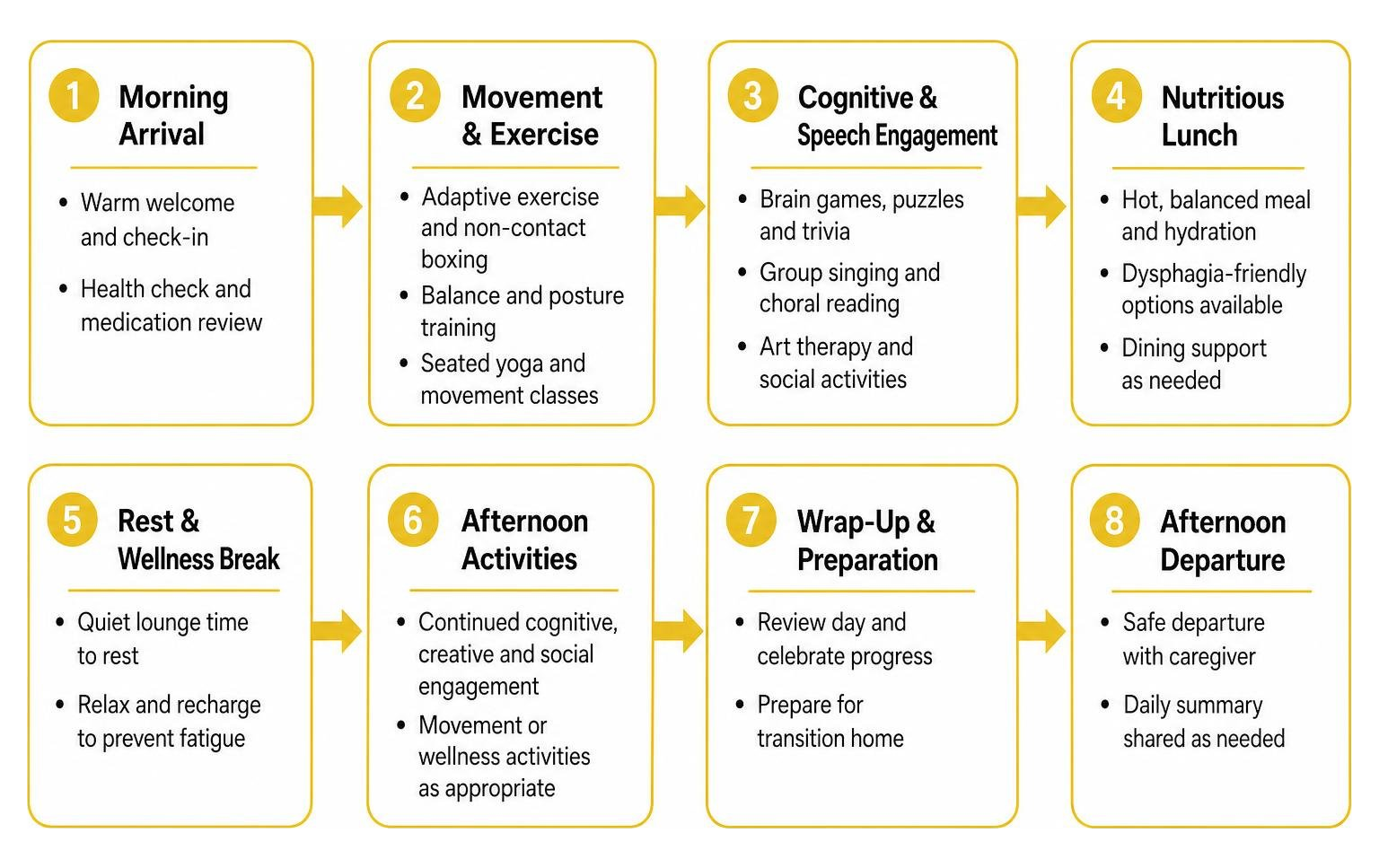
Daily programming at an adult day center is purposefully structured to address the exact physical, cognitive, and emotional symptoms associated with neurodegenerative movement disorders.
Targeted exercise is a cornerstone of Parkinson's care. Research shows that dynamic movement that challenges balance, coordination, and agility helps preserve functional mobility. Day centers may include movement opportunities that are adapted to participants' abilities.
These exercises emphasize:
Multi-Plane Movement: Training the body to twist, step sideways, and reach backward to counteract muscle rigidity.
Targeted Balance Training: Enhancing neuromuscular pathways to reduce fall risks during daily walking.
Postural Alignment: Counteracting forward-stooped posture through core strengthening and chest-opening stretches.
Adaptive Cardio: Safe aerobic routines designed as effective exercise for seniors over 60 to boost natural dopamine release and elevate daily energy levels.
Cognitive Support and Speech Engagement
Parkinson's impacts more than movement; it frequently alters vocal volume, facial expressiveness, and processing speed. Day centers provide rich cognitive and communication opportunities to help participants maintain mental sharpness.
Group word games, trivia, and strategic puzzles stimulate executive functioning and problem-solving skills. For individuals navigating both motor decline and cognitive changes, integrating structured brain games into a broader Parkinson's dementia care plan helps reduce confusion and anxiety. Group singing and choral reading naturally encourage participants to project their voices, working against hypophonia (soft speech). Group activities can help participants stay engaged and connected with others.
Nutrition, Wellness, and Daily Routine Support
Maintaining consistent energy and hydration is essential when managing Parkinson's medications. Adult day programs offer structured dining experiences featuring hot, balanced meals and scheduled hydration breaks throughout the day.
Staff members are trained to accommodate swallowing difficulties (dysphagia) by providing modified textures or adapted dining utensils when needed. Rather than treating daytime care purely as supervision, a quality center operates as a comprehensive senior wellness center, offering scheduled rest periods in quiet lounge areas between active sessions to help prevent mid-afternoon physical exhaustion.
Benefits for Individuals with Parkinson's and Family Caregivers
Full-time caregiving for a loved one with a progressive neurological disorder is physically demanding and emotionally exhausting. Family members often balance employment, parenting, and household management alongside full-time caregiving duties.
Using an adult day program gives family members reliable respite. It allows caregivers to work, attend to personal medical needs, or simply rest, knowing their loved one is safe and engaged. Utilizing regular daytime support provides vital Parkinson's caregiver burnout help before physical exhaustion turns into a medical crisis.
Implementing practical Parkinson's caregiving tips means building a sustainable care team rather than trying to handle every single task alone. As emphasized in resources on caring for the care giver, preserving caregiver wellness directly protects the care recipient's health. In fact, research from the Parkinson's Outcomes Project demonstrates that abrupt caregiver transitions are associated with a decline in clinical outcomes and health-related quality of life for individuals with Parkinson's. The study also revealed that women with Parkinson's often have fewer informal caregiving resources at home, making access to formal community-based care models essential for long-term stability.
Maintaining Independence and Quality of Life
Isolation is a quiet hazard for seniors living with Parkinson's. When motor symptoms make outings difficult, many individuals withdraw from social circles, accelerating cognitive and physical decline.
Attending a day program restores a sense of routine, purpose, and community belonging. Spending time with peers who understand the daily realities of tremors or balance changes fosters confidence and reduces social anxiety. This environment boosts self-esteem, provides essential respite care for dementia carers, and elevates the overall quality of life for the entire family unit.
Comparing Day Programs and In-Home Care

When seeking external support, families often evaluate whether an adult day center or in-home caregiving best fits their daily routine. Both options offer unique advantages depending on your family's schedule, budget, and care goals.
Care Feature | Adult Day Programs | In-Home Care Services |
|---|---|---|
Primary Setting | Licensed community day center | The participant's private residence |
Caregiver Respite | Predictable daytime blocks (e.g., 8 AM – 5 PM) | Flexible scheduling (hourly, overnight, or 24/7) |
Social Environment | Group dynamics, peer interaction, active games | One-on-one personal attention in a quiet home |
Exercise & Activities | Structured group fitness, music, and art | Customized home routines and neighborhood walks |
Cost Structure | Cost-effective flat daily or half-day rates | Hourly rates based on the number of care hours |
Best Suited For | Seniors seeking socialization and group energy | Individuals needing dedicated 1-on-1 home assistance |
Many families choose a blended care approach. For example, a senior might attend a day center two or three days a week for active group stimulation and utilize companion care at home for morning routines or weekend coverage. As care needs expand, consulting an in home care complete guide 2026 can help you determine when to combine daytime group programs with around-the-clock options like Parkinson's disease 24 hour care.
Costs and Financial Assistance Options
Cost is an important consideration when evaluating long-term care solutions. Adult day care is generally the most economical formal care model available, with daily rates typically costing a fraction of equivalent one-on-one in-home care hours or full-time residential assisted living.
To understand budget expectations, reviewing how much does adult day care cost provides clarity on local daily rates. Families can explore multiple funding avenues to help cover day program expenses:
Private Pay: Many families pay directly out-of-pocket using personal savings or retirement funds, selecting the exact number of days per week that fit their routine.
Long-Term Care Insurance: Most comprehensive long-term care insurance policies include adult day care benefits once a policyholder requires assistance with two or more ADLs.
Veterans Affairs (VA) Benefits: Eligible veterans may qualify for adult day program benefits or VA Community Care network vouchers to fund daytime supervision.
Medicaid HCBS Waivers: State Medicaid Home and Community-Based Services (HCBS) waivers frequently cover adult day services to help seniors avoid institutional nursing home placement. Families in Utah County can access local support networks and counseling through MAG Senior Help Guide resources to explore state-funded care programs.
How to Choose the Best Parkinson's Disease Adult Day Program
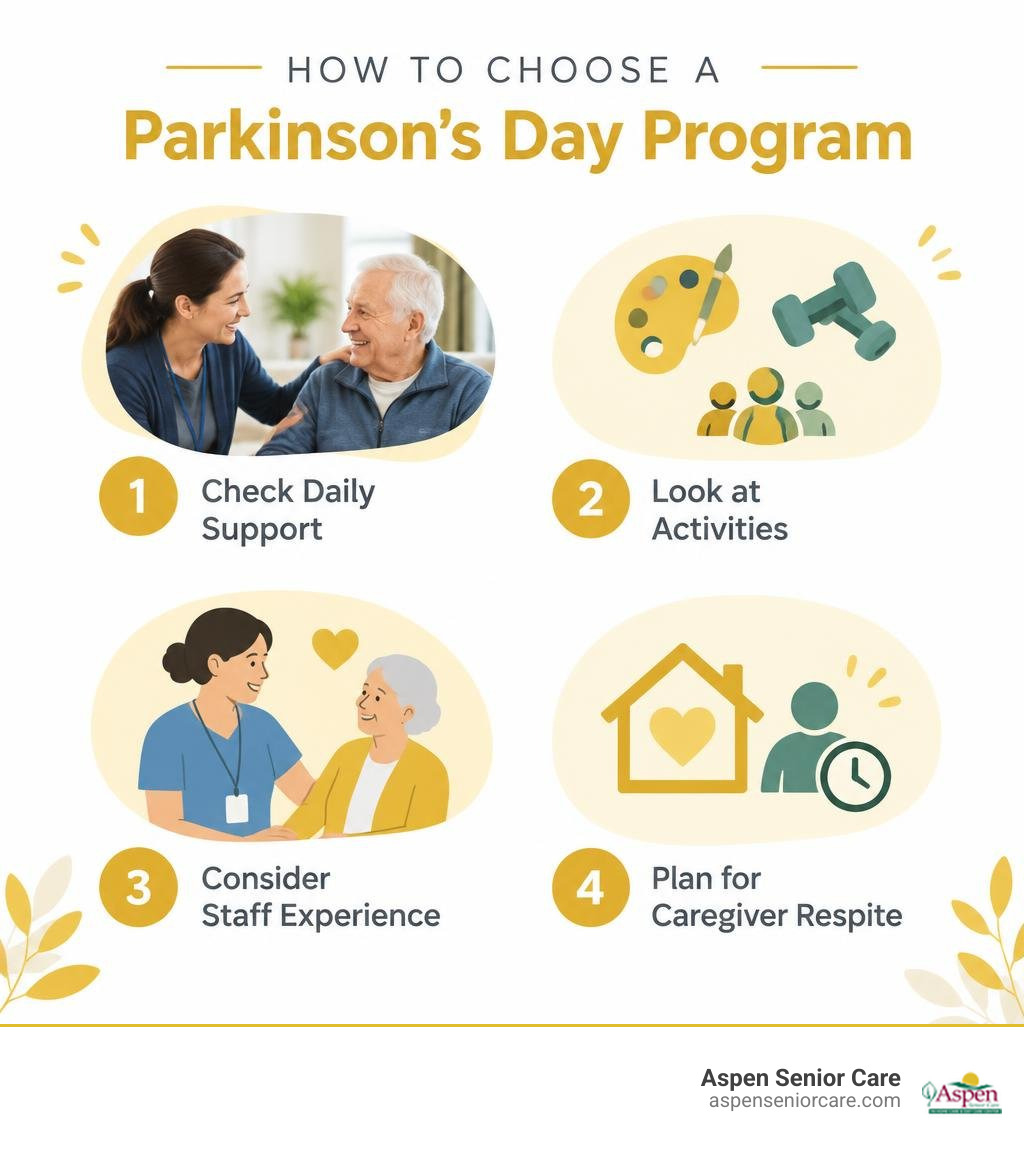
Selecting the right center requires assessing your loved one's specific physical and cognitive needs against the center’s capabilities. Quality senior daycare services prioritize safety, physical accessibility, and compassionate engagement.
When evaluating local centers, look for:
Low Staff-to-Participant Ratios: A low ratio ensures your loved one receives prompt assistance with walking, standing transitions, and bathroom visits.
Specialized Staff Training: Ask whether caregivers and activity coordinators receive dedicated education on movement disorders, freezing of gait, and fall prevention techniques.
Physical Accessibility: Ensure the facility features wide hallways, roll-in showers, zero-threshold entryways, and sturdy grab bars throughout.
Accreditation and Licensing: Centers accredited by recognized bodies, such as CARF International, demonstrate adherence to rigorous standards in rehabilitation and community care.
Questions to Ask During Your Tour
Before enrolling your parent, schedule an in-person tour during peak activity hours. Observing the atmosphere gives you clear insight into the community's energy and care quality.
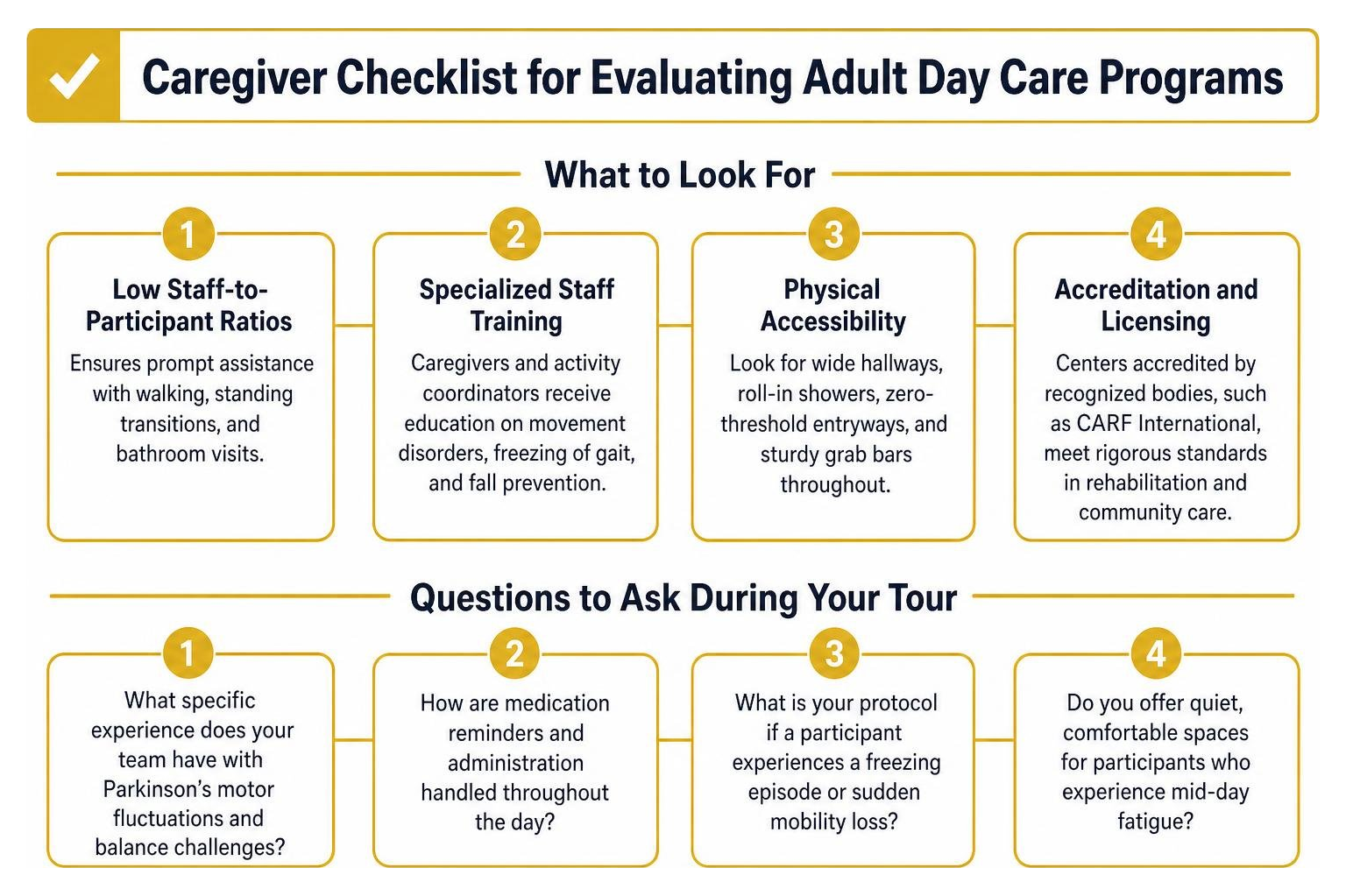
Take a practical checklist when exploring adult day programs near me and ask the director:
What specific experience does your team have with Parkinson's motor fluctuations and balance challenges?
How does your team communicate with families about medication schedules during the day?
What is your protocol if a participant experiences a freezing episode or sudden mobility loss?
Do you offer quiet, comfortable spaces for participants who experience mid-day fatigue?
Can we schedule a free or discounted half-day trial visit so my parent can experience the activities before enrolling?
Frequently Asked Questions About Parkinson's Day Centers
How does an adult day program handle Parkinson's medication timing and "off" periods?
Parkinson's medications (such as carbidopa/levodopa) require strict dosing schedules to prevent motor "off" periods where stiffness and tremors surge. Families should ask each center how it communicates about medication schedules and responds to sudden fatigue or motor fluctuations. Staff can provide quiet rest areas and gentle support within the center's policies.
Does Medicare pay for adult day care for Parkinson's disease?
Standard Medicare (Part A and Part B) generally does not cover custodial adult day care or social day programs. Medicare Advantage plans, Medicaid waivers, and VA Community Care benefits may offer daytime-support options, so families should review their plan details before enrolling.
How can I encourage a hesitant loved one to attend a day program?
It is common for seniors to resist the idea of "day care," often associating it with losing independence. Frame the center as a social club, wellness center, or fitness club focused on movement and exercise. Start small by arranging a short tour or a two-hour trial visit during a favorite activity, such as a musical performance or adapted fitness class, allowing friendships to develop naturally.
Conclusion
Navigating the daily complexities of Parkinson's disease requires a thoughtful balance of physical support, cognitive stimulation, and restorative rest for family caregivers. Enrolling in an adult day program allows your loved one to stay socially connected, build strength through specialized movement classes, and enjoy a vibrant routine while continuing to live safely at home.
At Aspen Senior Care, we provide award-winning, personalized support tailored to each stage of your family's journey—offering compassionate adult day programming and personalized in-home care throughout Utah Valley, including Orem, Provo, Lehi, American Fork, and surrounding communities. As you plan your family's care strategy, take time to understand the 5 Stages of PD so you can make confident, proactive decisions that support your parent's comfort and independence every step of the way.