
What to Expect as Parkinson's Disease Progresses over Time
What Are the Parkinson's Disease Stages — and What Do They Mean for Your Family?
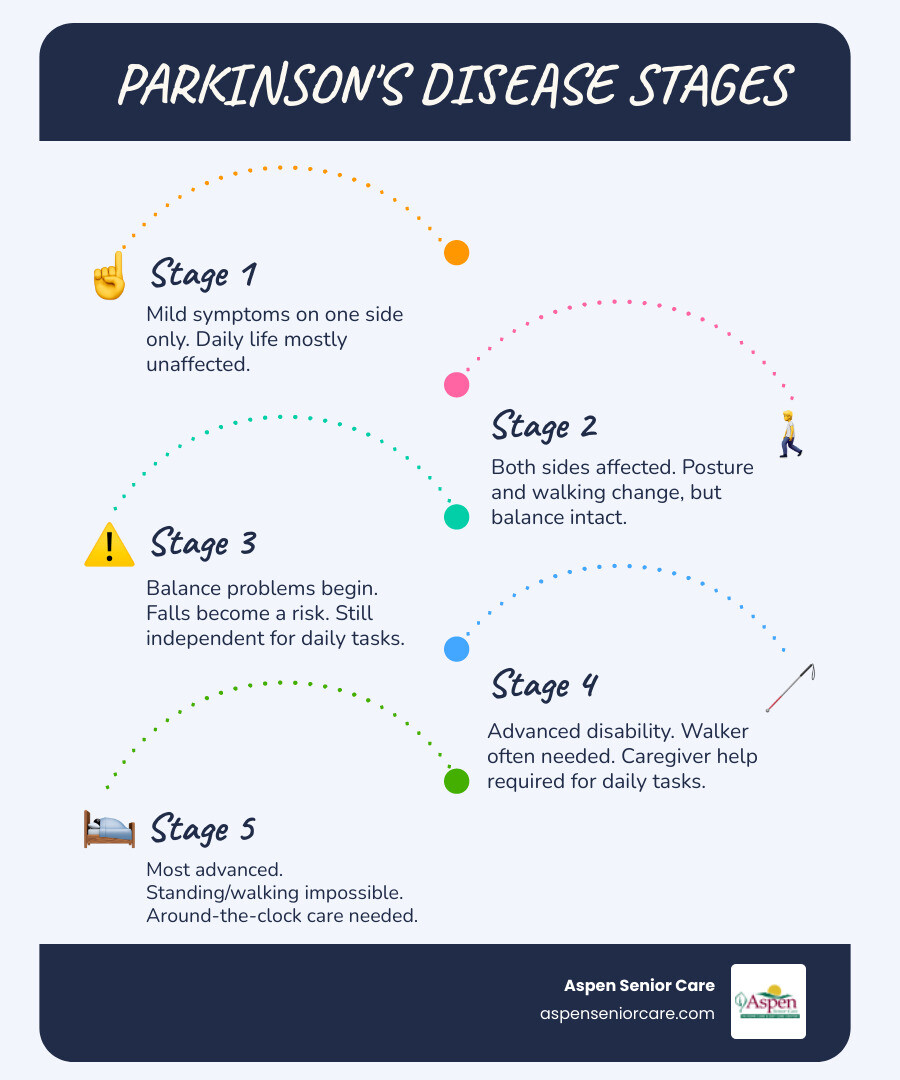
Understanding Parkinson's disease stages can help you and your family know what to expect — and plan ahead with confidence. Parkinson's is classified into five stages using the Hoehn and Yahr scale, ranging from mild, one-sided symptoms all the way to full-time care needs.
Here is a quick overview of the five stages:
Stage 1 — Mild, one-sided symptoms. Slight tremor or stiffness on one side of the body. Daily life is mostly unaffected.
Stage 2 — Bilateral symptoms. Both sides of the body are affected. Walking and posture may change, but balance is intact.
Stage 3 — Mid-stage. Balance problems begin. Falls become a risk. Most daily tasks are still possible independently.
Stage 4 — Advanced disability. A walker is often needed. Caregiver help is required for bathing, cooking, and other daily tasks.
Stage 5 — Most advanced. Standing and walking are no longer possible. Around-the-clock care is needed.
No two people follow the exact same path. Some people live in the early stages for many years. Others progress more quickly. On average, it takes 7 to 14 years from diagnosis to reach Stage 3, and 10 to 20 years to reach Stage 4 or 5 — though treatment and lifestyle choices can significantly influence that timeline.
What makes Parkinson's especially complex is that the visible, movement-related symptoms are only part of the picture. By the time a doctor makes a diagnosis, roughly 50% of the dopamine-producing cells in the brain have already been lost. And long before tremors appear, the disease may already be quietly affecting sleep, digestion, and mood.
If your parent or loved one has recently been diagnosed — or if you are trying to understand what lies ahead — this guide walks you through every stage, what symptoms to watch for, what care looks like, and how to build a support plan that works for your whole family.
Understanding the Five Parkinson's Disease Stages
To understand how the disease evolves, we look to the standard clinical framework: the Hoehn and Yahr scale. Developed in 1967 by neurologists Margaret Hoehn and Melvin Yahr, this scale classifies the progression of motor symptoms. Over the years, clinicians have modified it to include intermediate half-stages (like Stage 1.5 and Stage 2.5) to better capture the subtle shifts in mobility.
In clinical settings, doctors also rely on the Movement Disorder Society-Unified Parkinson’s Disease Rating Scale (MDS-UPDRS), which is a highly comprehensive tool. While the Hoehn and Yahr scale focuses heavily on motor impairment, the MDS-UPDRS tracks both motor and non-motor experiences of daily living. You can read more about how these scales compare on Stages of Parkinson's Disease — Hoehn and Yahr Scale and MDS-UPDRS | Parkinsons.org.
From a long-term perspective, motor progression in Parkinson's disease is relatively slow and linear, averaging about a 2% decline of the maximum motor disability score per annum. However, behind this steady math lies a deeply personal journey. Understanding these parkinson's disease stages helps families in Utah County anticipate changing needs rather than reacting to crises after they occur.
What to Expect in Early Parkinson's Disease Stages
In the early phases (Stages 1 and 2), symptoms are often subtle and manageable.
Stage 1: Mild, Unilateral Symptoms
In Stage 1, symptoms are strictly unilateral, meaning they affect only one side of the body. A loved one might experience a mild resting tremor in one hand — often described as a "pill-rolling" motion — or notice that one arm doesn't swing naturally when they walk. Mild stiffness or slight changes in facial expression (a "masked" face) may also appear.
Because these signs are so mild, they are frequently mistaken for normal signs of aging or essential tremors. During this stage, your loved one remains completely independent.
Stage 1.5: Unilateral and Axial Involvement
This intermediate stage is recognized when symptoms remain primarily on one side but begin to involve the neck and spine (axial structures), causing mild postural changes.
Stage 2: Moderate, Bilateral Symptoms
As the disease moves into Stage 2, symptoms become bilateral, affecting both sides of the body. Your loved one may experience increased muscle stiffness (rigidity) on both sides, making daily tasks slightly more time-consuming. You might notice:
A stooped posture.
A softer, more monotone speaking voice.
Difficulty with fine motor skills, such as buttoning a shirt or writing clearly.
Despite these changes, balance remains entirely intact. The individual can still walk independently and manage their own household.
Stage 2.5: Bilateral Symptoms with Mild Recovery Steps
At Stage 2.5, a person shows bilateral symptoms along with very early, mild balance issues. During a clinical evaluation, a doctor might perform a "pull test" (standing behind the patient and pulling gently backward on their shoulders). If the patient takes three or more steps backward to recover their balance but does not actually fall, they are classified at this intermediate stage.
For a deeper look at these early milestones, visit Stages of Parkinson's | Parkinson's Foundation.
Care Needs in Advanced Parkinson's Disease Stages
The transition from early to advanced stages is marked by a significant shift in balance and independence. This is often the most stressful period for family caregivers as the focus shifts to safety and fall prevention.
Stage 3: Mid-Stage Postural Instability
Stage 3 is considered the turning point in Parkinson's progression. While the individual is still physically independent, they now experience significant postural instability (balance impairment). Falls become a frequent hazard, particularly when turning around or stepping through doorways.
Walking may become slower, and "freezing of gait" — a temporary, involuntary inability to take a step — may begin to occur. More than half of all people with Parkinson's eventually experience gait freezing.
During Stage 3, we highly recommend implementing a home safety assessment, removing trip hazards, and introducing physical therapy focused specifically on balance.
Stage 4: Advanced, Significant Disability
In Stage 4, the disease causes severe disability. While your loved one may still be able to stand or walk a short distance with an assistive device like a walker, they can no longer live safely on their own. They require daily hands-on assistance with activities of daily living (ADLs), including:
Bathing and dressing.
Preparing meals.
Managing medications.
Safely transferring out of a chair or bed.
At this stage, family caregivers often experience high rates of burnout. Introducing professional in-home caregiving or utilizing specialized daytime programs becomes essential to ensure the safety of the senior and the well-being of the family.
Stage 5: Most Advanced Stage
Stage 5 is the most advanced stage of the disease. Severe muscle rigidity in the legs makes standing or walking impossible. Your loved one is confined to a wheelchair or bed. Around-the-clock, 24-hour care is required to assist with every physical movement, prevent bedsores, and manage advanced complications like severe swallowing difficulties (dysphagia).
At this point, care focuses entirely on comfort, dignity, and maximizing quality of life. For more clinical details on these advanced stages, see Stages of Parkinson's Disease | Massachusetts General Hospital.
To help visualize how symptoms and care needs evolve, we have compiled this comparative table:
Parkinson's Stage Primary Motor Symptoms Balance & Mobility Status Typical Caregiver & Support Needs Stage 1 One-sided tremors, mild stiffness, slight facial masking. Fully mobile; no balance issues. Independent; focus on exercise and establishing a medical baseline. Stage 2 Bilateral tremors, stiffness, stooped posture, speech changes. Good balance; fully mobile. Independent; home safety planning and physical therapy "pre-hab" recommended. Stage 3 Mid-stage symptoms; significant balance issues; slower movement. Postural instability; high fall risk. Independent for most tasks, but benefits from fall prevention and driving evaluations. Stage 4 Severe rigidity and bradykinesia; walking is highly limited. Requires walker; cannot stand or walk safely without help. Hands-on help needed daily for ADLs; respite care or day programs highly recommended. Stage 5 Complete stiffness; inability to stand or walk; severe dysphagia. Wheelchair-bound or bedridden. Requires continuous, 24/7 care for safety, hygiene, and comfort.
Beyond Motor Symptoms: The Limitations of Traditional Staging
While the Hoehn and Yahr scale is incredibly useful for tracking physical movement, it has one major limitation: it almost completely overlooks non-motor symptoms. For many families, these non-movement symptoms have a far greater impact on daily quality of life than physical tremors or stiffness.
According to Braak's hypothesis, Parkinson's pathology does not actually start in the movement centers of the brain. Instead, it is theorized to begin in the peripheral nervous system — specifically in the myenteric plexus of the gut and the olfactory bulb — potentially triggered by an environmental pathogen.
From there, abnormal aggregations of a protein called alpha-synuclein (which form toxic clumps known as Lewy bodies) slowly migrate up the vagus nerve to the brainstem, eventually reaching the substantia nigra and the cerebral cortex.
This path of progression explains why non-motor symptoms often appear a decade or more before the first physical tremor. These early, "prodromal" signs include:
Anosmia (loss of smell): Often one of the very first warning signs.
Chronic constipation: Driven by alpha-synuclein buildup in the enteric nervous system of the gut.
REM Sleep Behavior Disorder (RBD): A condition where a person physically acts out their dreams, sometimes thrashing or shouting in their sleep.
Mood changes: Such as depression, anxiety, and apathy, caused by changes in brain chemistry.
As the disease reaches its advanced stages and Lewy pathology spreads to the cerebral cortex, cognitive symptoms become more prominent. Mild cognitive impairment can eventually progress to Parkinson's disease dementia, which affects approximately one-third of all patients in the later stages.
These cognitive changes can lead to confusion, memory loss, and visual hallucinations. When a loved one begins to experience both physical and cognitive decline, specialized care becomes paramount.
If you are navigating these cognitive changes, our resources on Specialized Dementia Daycare can help you find structured, engaging environments designed to support cognitive health. For a comprehensive clinical reference on these non-motor complications, you can read the Parkinson Disease - StatPearls - NCBI Bookshelf.
Treatment Options and Interventions Across the Progression Timeline
While there is currently no cure for Parkinson's disease, a wide array of treatments can successfully manage symptoms and maintain independence for as long as possible.

Pharmacological Management
The gold standard medication for Parkinson's is carbidopa-levodopa. Levodopa is converted into dopamine in the brain, while carbidopa prevents it from breaking down before it gets there.
Early in the disease, levodopa provides a smooth, reliable response. In fact, the mean initial motor response to levodopa therapy is quite high — reducing pretreatment disability by about 40.3%.
However, as neurodegeneration continues, the brain loses its ability to store and buffer dopamine. The medication's effectiveness becomes tightly tied to its short plasma half-life. This leads to motor fluctuations:
"On" times: Periods when the medication is working well and movement is fluid.
"Off" times: Periods when the medication wears off, causing sudden stiffness and slow movement.
Dyskinesia: Involuntary, writhing movements that can occur when dopamine levels peak.
About half of all patients will develop these motor fluctuations and dyskinesias after five years of levodopa treatment. To manage this, specialists may adjust the dosing schedule, switch to extended-release formulations, or add secondary medications like dopamine agonists, MAO-B inhibitors, or COMT inhibitors.
To explore the full spectrum of antiparkinsonian medications, consult the Parkinson Disease - Neurology - Merck Manual Professional Edition.
Physical, Occupational, and Speech Therapies
Non-pharmacological therapies are just as vital as medication:
Physical Therapy: Focuses on gait training, strength, and balance. Starting physical therapy early helps seniors build a safe exercise routine before balance issues arise.
Occupational Therapy: Helps seniors adapt their homes and learn new techniques for bathing, dressing, and writing.
Speech Therapy (such as LSVT LOUD): Parkinson's often weakens the vocal cords and swallowing muscles. Specialized speech programs train seniors to speak louder and swallow safely, reducing the risk of aspiration.
When to Consider Deep Brain Stimulation (DBS)
For individuals experiencing severe motor fluctuations that can no longer be controlled with oral medications, Deep Brain Stimulation (DBS) is a highly effective surgical option. First approved by the FDA for Parkinson's in 2002, DBS involves placing thin electrodes into specific areas of the brain (usually the subthalamic nucleus or globus pallidus) connected to a small pacemaker-like device in the chest.
Benefits of DBS
DBS does not cure Parkinson's, but it acts like a "brain pacemaker" to stabilize motor symptoms. On average, DBS can:
Increase "on" time by 3 to 4 hours per day.
Reduce involuntary dyskinesia.
Allow patients to reduce their daily medication dosages by an average of 50%.
DBS Candidacy Criteria
The ideal window for DBS is during Stage 2 or Stage 3, once motor fluctuations become disruptive but before severe balance issues or cognitive decline set in. DBS does not improve balance or treat cognitive symptoms; in fact, undergoing DBS with existing cognitive decline can worsen confusion.
General candidacy criteria include:
A diagnosis of Parkinson's for at least four years.
A clear, positive motor response to levodopa (showing that the underlying pathways are responsive).
Motor fluctuations or tremors that are not adequately controlled by optimized medications.
No significant cognitive impairment or dementia.
The Role of Palliative Care in Parkinson's Management
Many people confuse palliative care with hospice or end-of-life care. In reality, palliative care is specialized medical care focused on providing relief from the symptoms and stress of a serious illness. It is designed to improve quality of life for both the patient and the family.
Palliative care can — and should — be integrated early in the Parkinson's journey, even at the time of diagnosis. A multidisciplinary palliative care team works alongside your primary neurologist to address:
Complex symptom management (such as pain, sleep disturbances, and anxiety).
Emotional and spiritual support.
Advance care planning and goals-of-care discussions.
Caregiver support and coping strategies.
By introducing palliative care early, families can navigate the emotional and physical challenges of Parkinson's with a dedicated team of specialists supporting them every step of the way.
Frequently Asked Questions about Parkinson's Progression
How quickly does Parkinson's disease progress?
Parkinson's is a slowly progressive disease, and its rate of progression varies dramatically from person to person. On average, motor disability progresses at a linear rate of about 2% of the maximum score annually.
However, during the prodromal phase (the years before a formal diagnosis is made), motor scores can worsen at a faster rate of 5.2% to 7.5% per annum as the brain's natural compensatory mechanisms begin to fail.
Factors that influence progression include age at onset (older age at diagnosis is sometimes associated with faster cognitive changes), genetics, and lifestyle factors like regular cardiovascular exercise, which has been shown to help slow the rate of physical decline.
What is the leading cause of death in advanced Parkinson's?
Parkinson's disease itself is not directly fatal. However, advanced complications of the disease can be life-threatening. The leading cause of death in advanced Parkinson's is aspiration pneumonia.
In Stage 5, severe swallowing difficulties (dysphagia) make it easy for food, liquids, or saliva to accidentally enter the airway and travel into the lungs, leading to serious infections. Working closely with speech therapists and modifying food textures in the later stages are crucial steps to prevent this complication.
Can lifestyle changes slow down Parkinson's progression?
Yes! While no medication can slow or stop the progression of Parkinson's, there is strong, clinical evidence that regular cardiovascular exercise can help protect brain health and maintain physical function.
We recommend aiming for 20 minutes of heart-rate-elevating exercise, five times per week. Specialized programs like Rock Steady Boxing (non-contact boxing training) and Dance for PD are highly effective and widely available.
Additionally, eating a balanced, fiber-rich diet supports gut health, reduces constipation, and helps the body absorb medications more effectively.
Conclusion

Living with Parkinson's disease is a journey of continuous adaptation. While the parkinson's disease stages outline a general roadmap of what to expect, they do not define your loved one's unique path. With proactive medical care, regular physical activity, and a strong support network, seniors with Parkinson's can maintain a high quality of life for many years.
As care needs change — especially during the transitions of Stages 3, 4, and 5 — you do not have to navigate these challenges alone. At Aspen Senior Care, we provide award-winning, family-like, personalized non-medical care across Utah Valley, including Orem, Provo, Lehi, American Fork, Pleasant Grove, and Spanish Fork.
Whether your loved one needs companion care to stay active, hands-on assistance with daily tasks at home, or specialized care, we are here to help.
Our specialized Parkinson's Senior Day Center programs in Orem offer structured exercise, social engagement, and cognitive stimulation in a safe, warm environment, giving family caregivers valuable peace of mind and well-deserved respite.
If your family is managing both physical and cognitive changes, we also offer specialized resources through our Senior Day Center Dementia and Senior Day Center Memory Care programs.
For families requiring more comprehensive support, we provide dedicated 24 Hour Dementia Care to ensure your loved one is safe and comfortable around the clock.
Be proactive in your care journey. Reach out to our team at Aspen Senior Care today to discuss how we can support your family and help your loved one live safely, comfortably, and with dignity at every stage of Parkinson's.