
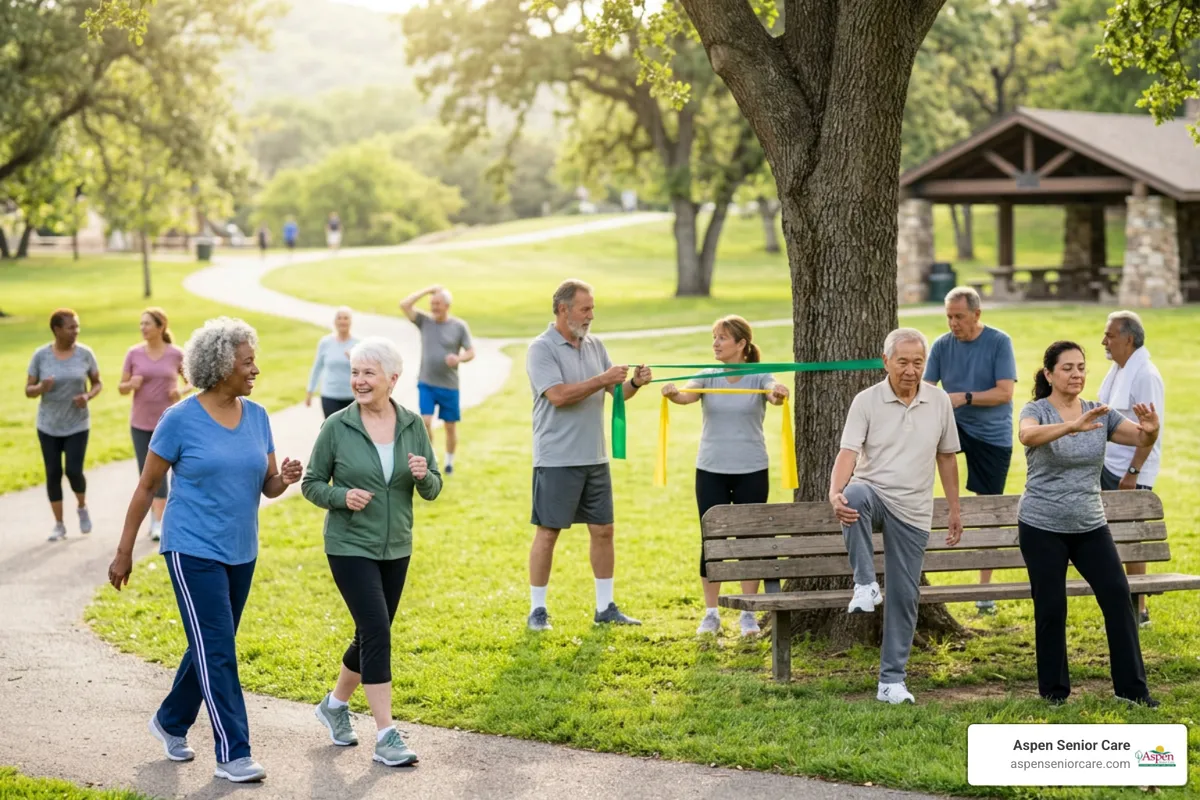
The Complete Guide to Safe Exercise for Seniors Over 60
Safe Exercise for Seniors Over 60 Starts With Four Types of Movement
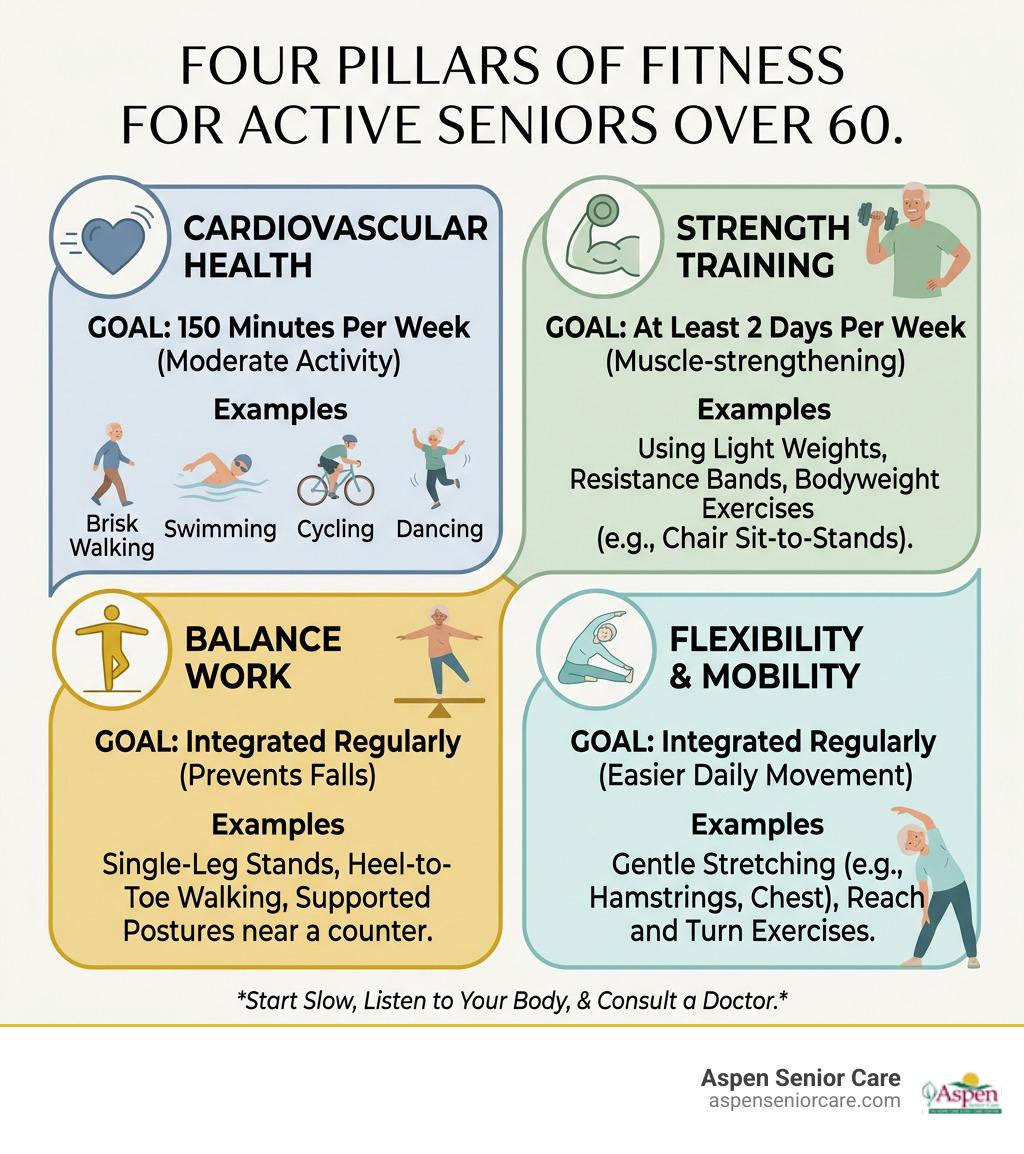
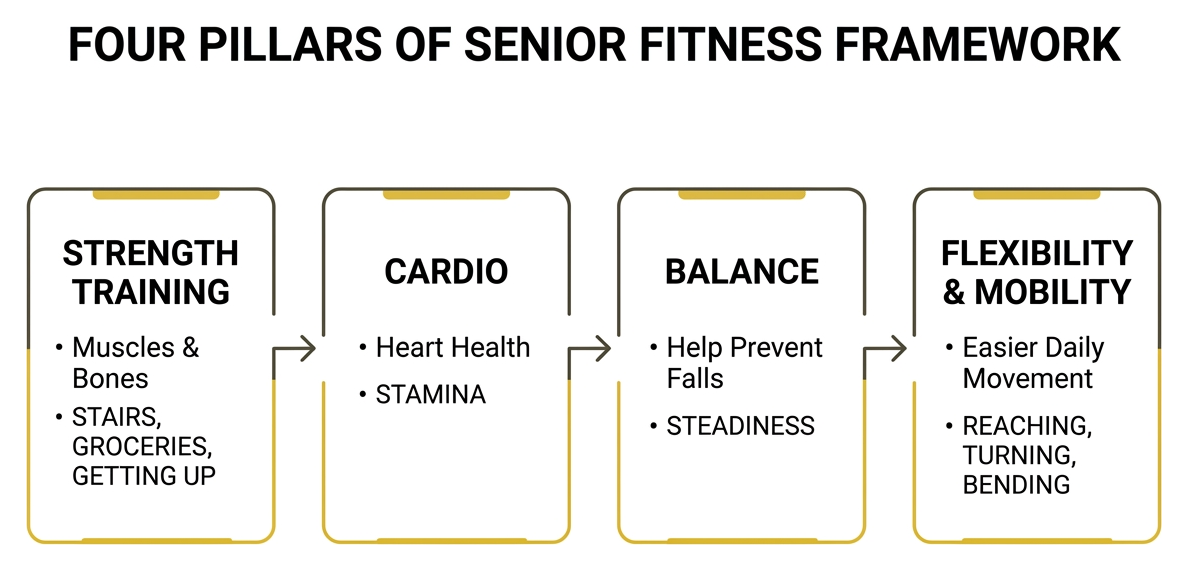
The best exercise for seniors over 60 combines four areas: cardio for heart health, strength training for muscles and bones, balance work to help prevent falls, and flexibility or mobility for easier daily movement. Start small: take a short walk, do a few chair sit-to-stands or wall push-ups, practice supported balance near a counter, and finish with gentle stretches.
Adults age 65 and older should work toward at least 150 minutes of moderate activity each week, such as brisk walking, plus muscle-strengthening activity at least twice weekly. Those minutes can be split into manageable 10- or 15-minute sessions.
This mix matters because each type supports a different part of independence. Strength helps with stairs, groceries, and getting up from a chair. Cardio supports stamina. Balance improves steadiness. Mobility makes reaching, turning, and bending safer and more comfortable.
For an older parent who has been inactive, has joint pain, or manages a chronic condition, the safest first step is to check with their clinician and begin at a level that feels comfortable. Mild effort is fine; sharp pain, chest pain, dizziness, or unusual shortness of breath is not.
The 4 Pillars of Exercise for Seniors Over 60

As we age, relying on just one form of exercise—like a casual evening stroll—is not quite enough to preserve long-term vitality. Our bodies require a multi-faceted stimulus to stay resilient. Combining strength, cardiovascular conditioning, balance, and flexibility builds functional fitness, which means maintaining the physical capacity to carry groceries, climb stairs, bend down to tie shoes, and play with grandchildren without assistance or fear of injury.
Without intentional movement, the natural aging process leads to sarcopenia (age-related muscle wasting), reduced bone mineral density, stiffening joints, and sluggish neuromuscular reflexes. Addressing all four pillars creates a protective barrier against physical decline, helping you maintain self-reliance and energy throughout your golden years.
Strength Training and Muscle Preservation
Once you turn 30, your body begins losing up to 8 percent of its muscle mass per decade, an involuntary process that accelerates significantly after age 60. This loss of lean tissue directly affects resting metabolic rate, increases the burden on weight-bearing joints, and raises the risk of physical frailty.
Fortunately, muscle tissue remains remarkably adaptable at any age. Engaging in progressive resistance training stimulates muscle protein synthesis, strengthens connective tendons, and signals bones to retain calcium and mineral density. Furthermore, resistance training provides substantial cardiovascular advantages; a 2025 study published in Archives of Gerontology and Geriatrics demonstrated that regular resistance training significantly lowers resting blood pressure in adults aged 60 and older.
You do not need heavy gym machinery or barbell weights to reap these rewards. Practicing a guided 15-minute strength routine using basic bodyweight or resistance bands two to three days a week is plenty to preserve muscle mass, support posture, and stabilize blood sugar levels.
Low-Impact Cardiovascular Conditioning
Aerobic exercise trains your heart and lungs to deliver oxygenated blood efficiently throughout your body. The Centers for Disease Control and Prevention (CDC) recommends that adults aged 65 and older accumulate at least 150 minutes of moderate-intensity aerobic activity per week (roughly 30 minutes a day, five days a week), or 75 minutes of vigorous activity.
Consistent cardiovascular training yields profound physical and mental protective effects:
Cognitive Preservation: A 2025 study published in JAMA Network Open revealed that individuals who maintained higher physical activity levels across midlife and late life had a greater than 40 percent lower risk of developing dementia compared to inactive peers.
Immediate Systemic Benefits: Even a single session of moderate cardio can improve that night's sleep quality and temporarily lower blood pressure.
Disease Prevention: Daily aerobic movement, aiming for a target of 8,000 to 10,000 steps daily, dramatically lowers the risk of stroke, type 2 diabetes, and coronary artery disease.
For seniors managing sensitive knees or hips, high-impact running is unnecessary. Low-impact options—such as brisk walking, stationary cycling, water aerobics, or lap swimming—deliver cardiovascular benefits without stressing joint cartilage. Those looking for social, structured aquatic or track facilities can explore local community recreation programs to stay active year-round.
Balance Training to Prevent Falls
Falls represent the leading cause of accidental injury, hospital visits, and loss of independence among adults over 60. As time passes, the sensory systems responsible for balance—vision, inner ear vestibular function, and muscle proprioception (the body's awareness of where limbs are positioned)—can dull if not actively challenged.
Balance training sharpens the communication between your nervous system and your stabilizing muscles. Incorporating dynamic footwork and controlled weight-shifting exercises, such as slow-motion Tai Chi walking techniques, trains your legs and core to react instantly when navigating uneven pavements or slippery thresholds. Practicing balance drills near a wall or sturdy table three or more days per week creates the physical stability needed to move with confidence.
Mobility and Flexibility for Daily Living
Flexibility refers to the ability of your muscles to lengthen, while mobility is the ability of your joints to move actively through their full, unrestricted range of motion. Age-related collagen changes and prolonged sedentary sitting often cause shoulders to round forward, hip flexors to tighten, and ankles to stiffen.
Stiff joints make everyday movements difficult—reaching into top cupboards, looking over your shoulder while reversing a car, or bending down to trim your toenails can turn into frustrating struggles. Daily mobility work lubricates joints with synovial fluid, restores postural alignment, and prevents compensation patterns that trigger lower back and hip discomfort.
Safe and Effective Workout Moves to Do at Home
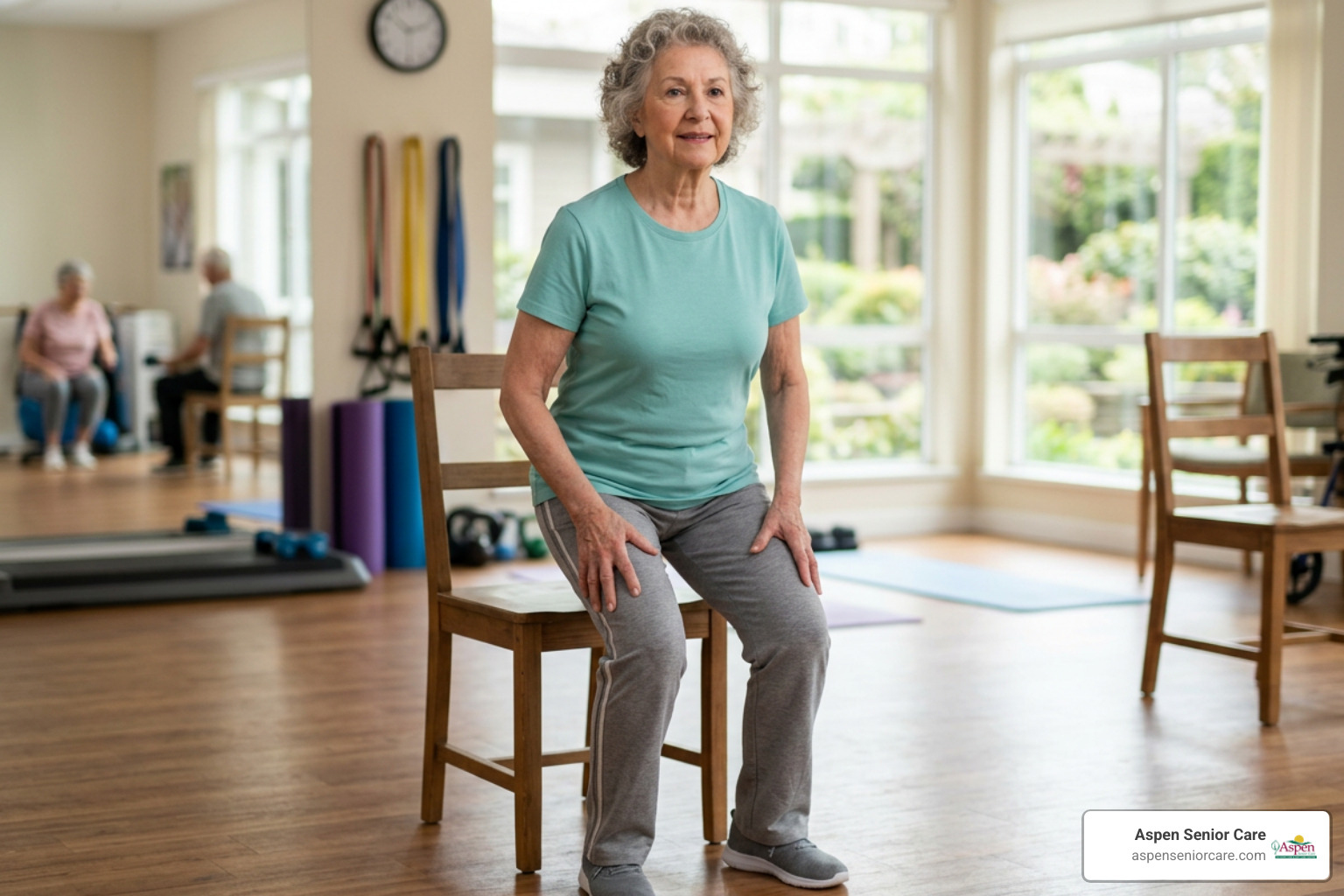
You do not need an expensive gym membership or complex equipment to build a functional body. Your living room offers everything necessary to develop strength, stability, and mobility using simple bodyweight movements, a sturdy dining chair, and a clear wall.
Beginner Strength and Core Exercises for Seniors Over 60
Perform these functional strength exercises 2 to 3 times per week on non-consecutive days. Focus on deliberate, controlled execution rather than speed.
Chair Sit-to-Stand: Sit upright toward the front edge of a sturdy chair with feet flat on the floor, hip-width apart. Cross your arms over your chest (or extend them forward for counterbalance). Lean slightly forward from your hips, press firmly through your heels, and stand up straight without using your hands if possible. Pause, squeeze your glutes, then slowly hinge your hips back and lower yourself down under control.
Wall Push-Up: Stand facing a clear wall, roughly two feet away. Place your palms flat against the wall at shoulder height and shoulder-width apart. Keeping your body in a straight line from heels to crown, bend your elbows and lower your chest toward the wall. Press evenly through your hands to return to the starting position.
Standing Heel Raise: Stand behind a sturdy chair, resting your fingertips lightly on the backrest for balance. Slowly lift your heels as high as comfortably possible, balancing on the balls of your feet. Hold for one full second at the top, then slowly lower your heels back to the floor.
Seated Band or Towel Row: Sit upright on a chair with your legs extended slightly forward. Loop an exercise resistance band or rolled towel around the arches of your feet, holding the ends with both hands. Pull your elbows straight back alongside your ribs, drawing your shoulder blades together as if pinching a pencil between them. Slowly return to the starting position.
Standing Core Brace: Stand tall with soft knees and hands resting lightly on your hips. Inhale deeply into your belly, then exhale forcefully as if blowing through a straw while drawing your navel in toward your spine. Hold that abdominal tension for 15 to 20 seconds while continuing to breathe shallowly, then release.
Gentle Balance and Mobility Drills
These gentle drills can be performed daily—even while waiting for your morning tea to brew.
Weight Shifting: Stand with feet shoulder-width apart near a counter. Slowly shift your entire weight onto your right foot until your left foot is resting lightly on its big toe. Hold for 5 seconds, then slowly transition your weight across to the left foot. Repeat 5 times per side.
Tandem Stance (Heel-to-Toe Hold): Stand next to a wall. Place your right foot directly in front of your left foot so your right heel touches your left toes, mimicking a tightrope stance. Fix your eyes on a stationary point ahead and hold for 15 to 30 seconds. Switch foot positions and repeat.
Ankle Circles: While seated or standing with hand support, lift one foot slightly off the floor. Slowly rotate your foot in a wide circle 10 times clockwise, then 10 times counter-clockwise. Switch feet.
Shoulder Blade Squeezes & Rolls: Sit or stand tall with arms relaxed at your sides. Roll your shoulders up toward your ears, back, and down in a fluid circular motion 8 times. Follow this by pulling your elbows back and squeezing your shoulder blades together firmly for 3 seconds; repeat 5 times.
Gentle Neck Stretches: Sit tall with shoulders relaxed. Slowly drop your right ear toward your right shoulder until you feel a comfortable stretch along the left side of your neck. Hold for 15 to 20 seconds without forcing the movement. Repeat on the left side.
Creating a Balanced Weekly Routine
Establishing an exercise habit requires balance—doing enough to trigger healthy adaptations while allowing adequate recovery for muscles, joints, and the nervous system.
The weekly schedule below illustrates how a senior beginner can comfortably balance aerobic activity, strength work, balance drills, and mobility across seven days to meet the 150-minute moderate exercise benchmark.
Day | Primary Focus | Workout Breakdown | Total Active Time |
|---|---|---|---|
Monday | Strength & Core + Balance | 5-min Warm-Up + 15-min Home Strength Circuit + 5-min Balance Drills + 5-min Stretch | 30 Minutes |
Tuesday | Low-Impact Cardio & Mobility | 25-min Brisk Walking or Water Aerobics + 5-min Ankle & Shoulder Mobility | 30 Minutes |
Wednesday | Active Recovery | 20-min Gentle Scenic Walk + 10-min Full-Body Gentle Stretching | 30 Minutes |
Thursday | Strength & Core + Balance | 5-min Warm-Up + 15-min Home Strength Circuit + 5-min Balance Drills + 5-min Stretch | 30 Minutes |
Friday | Low-Impact Cardio & Mobility | 25-min Interval Walking or Stationary Cycling + 5-min Neck & Hip Mobility | 30 Minutes |
Saturday | Functional Social Activity | 30-40 min Gardening, Dancing, or Attending structured senior community programs | 30–40 Minutes |
Sunday | Rest & Rejuvenation | Rest day, light household pottering, short casual strolls as desired | Flexible |
Progression, Pacing, and Perceived Exertion
When starting out, knowing how hard to push yourself can be tricky. A reliable guideline is the Perceived Exertion Scale (RPE) paired with the Talk Test:
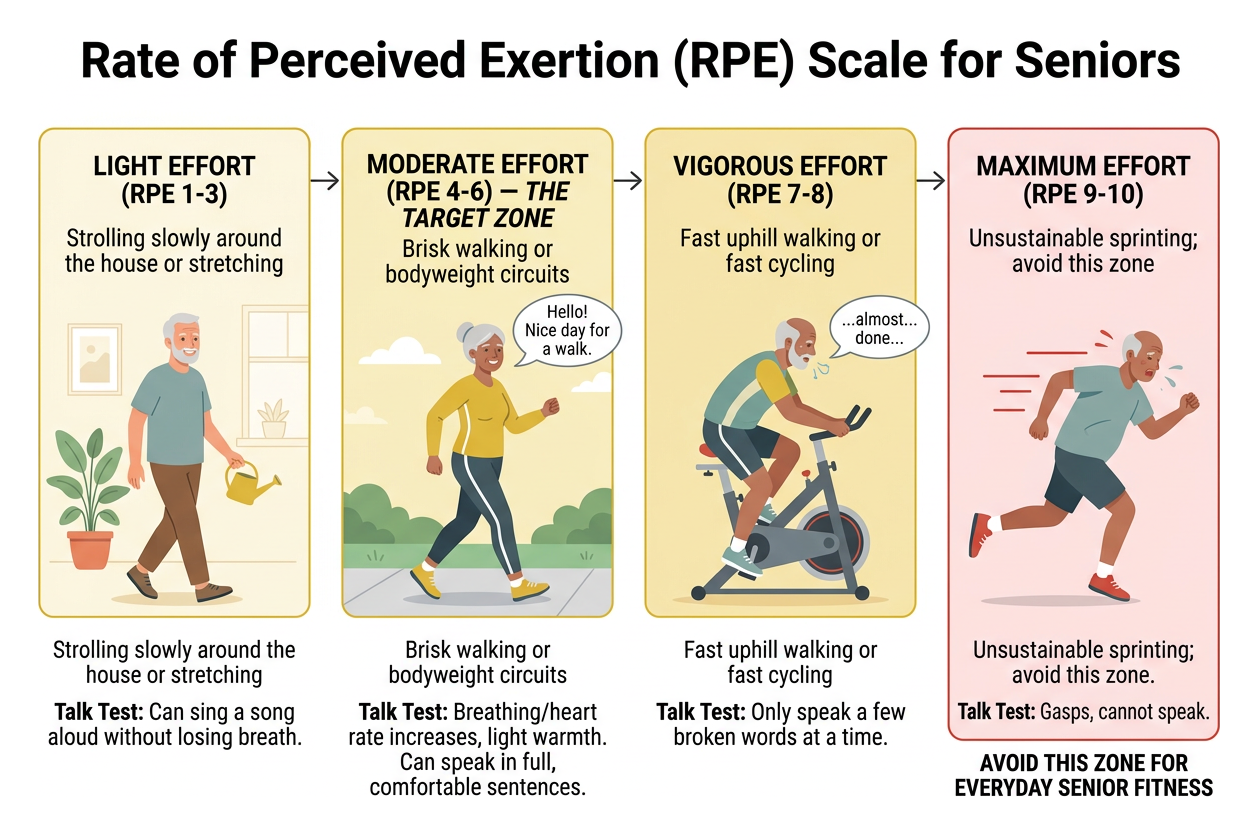
Light Effort (RPE 1–3): Strolling slowly around the house or stretching. You can sing a song aloud without losing your breath.
Moderate Effort (RPE 4–6) — The Target Zone: Brisk walking or bodyweight circuits. Your breathing and heart rate increase, and you develop a light warmth, but you can still speak in full, comfortable sentences. If you cannot speak without gasping, slow down.
Vigorous Effort (RPE 7–8): Fast uphill walking or fast cycling. You can only speak a few broken words at a time.
Maximum Effort (RPE 9–10): Unsustainable sprinting; avoid this zone during everyday senior fitness training.
To make progress safely, use the 2-for-2 Rule: When you can perform two additional repetitions beyond your target rep range during the final set of an exercise for two consecutive workouts with clean form, you are ready to progress. You can advance by adding a light resistance band, holding a small water bottle, or slightly slowing your movement tempo.
Safety Guidelines and Modifications for Chronic Conditions
Physical activity is safe for almost every older adult, including those living with chronic illnesses. However, practicing exercise with situational awareness and proper modifications is essential to prevent setbacks.
Before beginning a new exercise program, schedule a conversation with your healthcare provider—particularly if you have a history of heart disease, uncontrolled hypertension, diabetes, joint replacements, or dizziness. Review our practical caregiver resources for helpful checklists on discussing physical activity with doctors and family members.
Managing Arthritis, Osteoporosis, and Limited Mobility
Chronic conditions require smart adjustments, not sedentary habits:
Osteoarthritis: When joints are stiff or inflamed, avoid high-impact jumping or pounding exercises. Opt for warm water aerobics, stationary cycling, or smooth chair exercises. Always move joints through a comfortable, pain-free range of motion. A mild muscular ache is normal, but sharp or swelling-inducing joint pain is a signal to stop.
Osteoporosis: When bone mineral density is compromised, avoid movements involving loaded spinal flexion (such as traditional sit-ups or bending forward to touch your toes with straight legs) and forceful spinal twisting. Focus instead on tall posture, neutral-spine hip hinges, wall push-ups, and gentle stepping to stimulate bone retention safely.
Limited Mobility or Wheelchair Use: Every standing movement can be adapted into a seated equivalent. Seated marches, seated torso rotations, seated overhead reaches, and resistance band rows provide upper-body strength, core activation, and cardiovascular stimulation from a safe, seated base.
Starting Safely After Inactivity
If you have been inactive for months or years, the idea of jumping into a 30-minute workout can feel overwhelming. Remember: consistency always beats intensity.
You do not need to do 30 continuous minutes on day one. Break your movement into three 5-minute walks or gentle movement sessions spread across the day. As your stamina builds, expand those blocks to 10 minutes, then 15 minutes.
If keeping up with a daily routine or managing balance at home feels challenging, our team provides personalized in-home care support to help older adults across Utah County—including Orem, Provo, Lehi, and American Fork—stay safe, active, and supported right in the comfort of home.
Frequently Asked Questions About Senior Fitness
Finding clear, sensible answers to common exercise questions helps remove hesitation. Here are practical solutions to frequently asked questions, with more answers available in our answers to common senior wellness questions section.
How often should adults over 60 exercise each week?
Older adults should aim for at least 150 minutes of moderate-intensity aerobic exercise each week (such as 30 minutes a day, 5 days a week), alongside muscle-strengthening activities at least 2 days per week. In addition, balance exercises and flexibility stretches should ideally be practiced 3 to 7 days a week to maintain joint function and prevent accidental falls.
Can you build muscle after age 60 or 70?
Yes, absolutely. Clinical research confirms that skeletal muscle remains responsive to resistance training throughout your 70s, 80s, and 90s. When you perform progressive strength exercises and consume adequate dietary protein (roughly 1.0 to 1.2 grams of protein per kilogram of body weight daily, unless medically restricted), your body continues to synthesize new muscle tissue, improve neuromuscular coordination, and increase functional strength.
What should you do if an exercise causes joint discomfort?
If you feel sudden, sharp, pinching, or stabbing pain while performing an exercise, stop immediately. Differentiate between normal muscle fatigue (a warm, tired sensation in the belly of the muscle) and joint distress (pain inside the joint capsule, tendon tenderness, or sharp nerve twinges).
Try reducing your range of motion, lightening the resistance, or switching to a supported seated variation. If the pain persists beyond 24 hours or is accompanied by joint swelling or redness, consult your physical therapist or primary care physician for a formal evaluation.
Conclusion
Staying active after 60 is not about running marathons or lifting heavy weights—it is about preserving your freedom, keeping your mind sharp, and feeling confident in your own body every single day. By balancing strength training, low-impact cardio, balance drills, and daily mobility work, you build a resilient foundation for long-term independence.
At Aspen Senior Care, we believe that aging should be vibrant, purposeful, and filled with community connection. Whether through attentive one-on-one companionship at home or through our enriching senior day center programs in Utah Valley, we are dedicated to helping seniors stay active, engaged, and thriving.
Put on a supportive pair of shoes, grab a glass of water, and take that first 5-minute walk or practice your first set of chair sit-to-stands today. Your future self will thank you for every single step.