

ADLs vs IADLs: A Practical Guide to Daily Living Assessments
IADLs vs ADLs: What Kind of Help Does Your Parent Need?
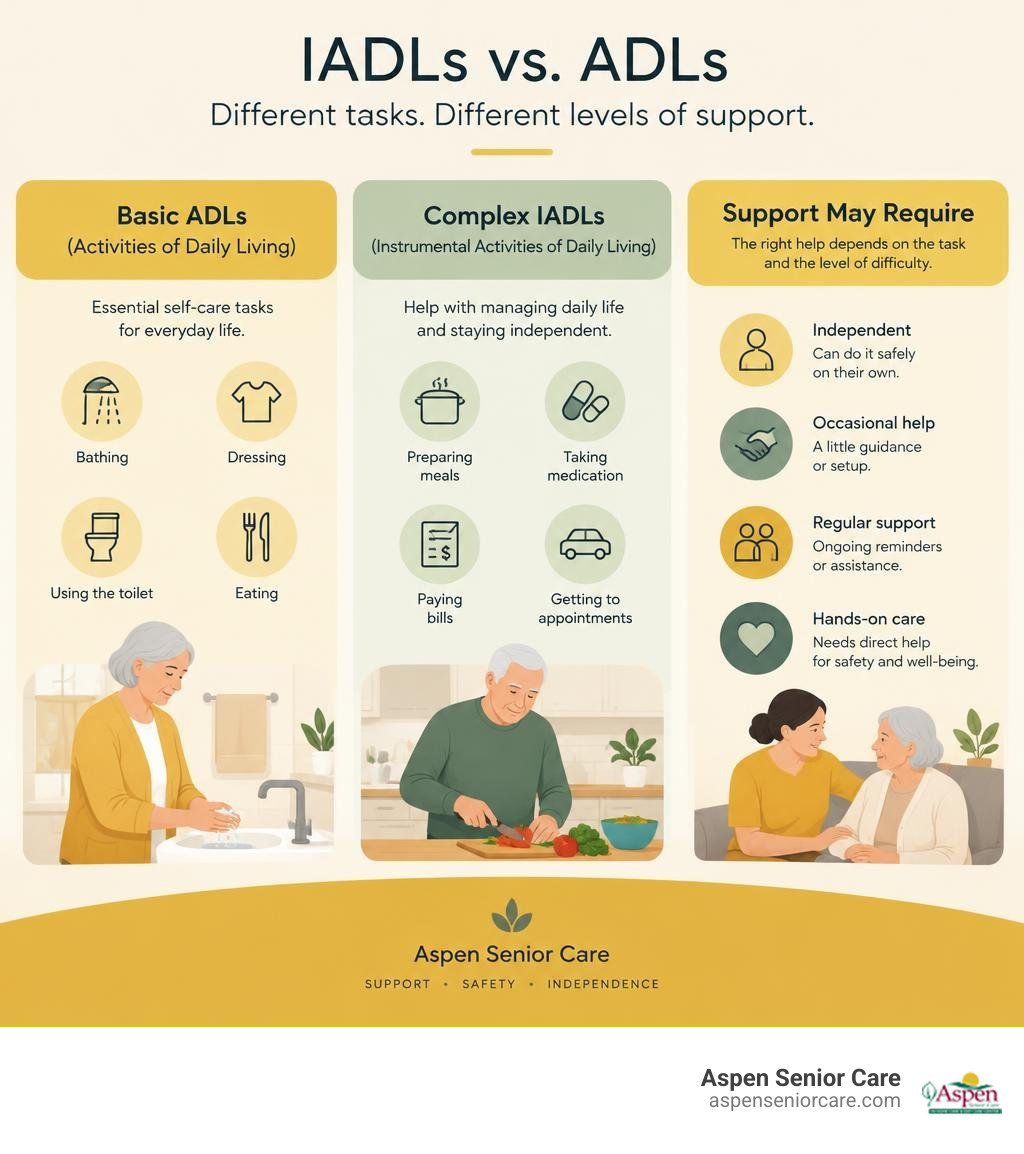
For families comparing iadls vs adls, the difference is what the task helps a person do. ADLs are basic self-care tasks, such as bathing, dressing, using the toilet, and eating. IADLs are more complex tasks needed to live independently, such as preparing meals, taking medication correctly, paying bills, and getting to appointments.
A parent may manage personal care but still need help with meals or medication. Trouble with IADLs can be an early sign that support is needed; trouble with ADLs often calls for more hands-on care. Notice which tasks have changed, how often help is needed, and whether your parent can do them safely. Share those details with a healthcare provider to guide a care assessment.
IADLs vs ADLs: Key Differences and Functional Levels
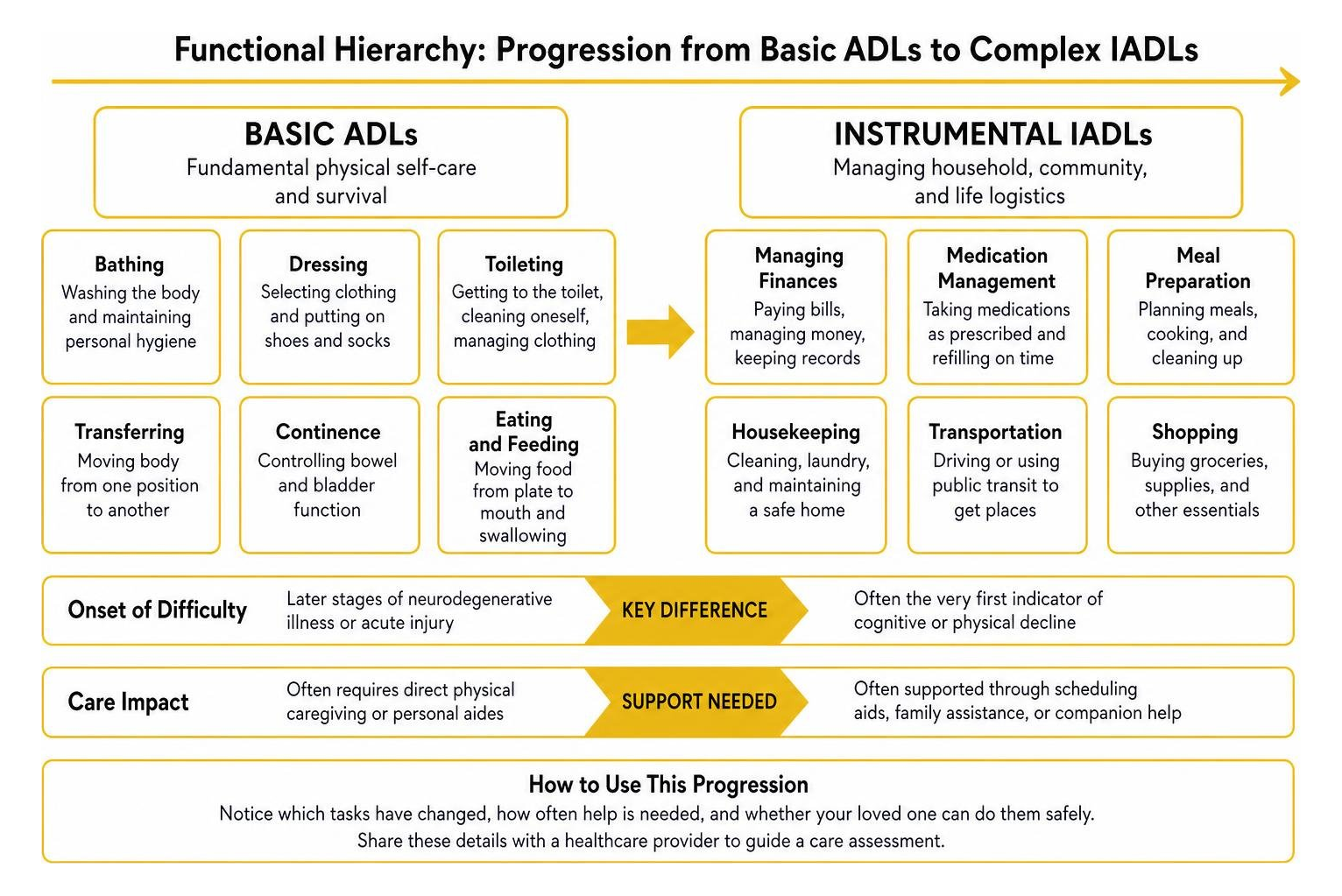
Understanding daily functional capacity is essential when mapping out care needs for an aging loved one. While both metrics measure personal capability, they evaluate fundamentally different tiers of daily life. Evaluating basic self-care alongside complex environmental navigation reveals the exact level of support someone requires to live safely and comfortably.
Domain Feature | Basic ADLs (Activities of Daily Living) | Instrumental ADLs (IADLs) |
|---|---|---|
Core Focus | Fundamental physical self-care and survival | Managing household, community, and life logistics |
Cognitive Requirement | Habitual, motor-based routines | High executive functioning, planning, and memory |
Onset of Difficulty | Later stages of neurodegenerative illness or acute injury | Often the very first indicator of cognitive or physical decline |
Primary Goal | Maintaining personal hygiene, safety, and nutrition | Preserving self-reliance and community independence |
Care Setting Impact | Often requires direct physical caregiving or personal aides | Often supported through scheduling aids, family assistance, or companion help |
As seniors age, approximately 77% express a clear desire to age in place rather than move to a facility. Distinguishing between functional levels allows families across Utah Valley—from Lehi to Payson—to tailor care plans so older adults can remain in their homes safely. Exploring clinical resources, such as medical reviews on functional assessment, helps clarify how these tasks build upon one another.
Basic Activities of Daily Living (ADLs) Explained
In the 1950s, Dr. Sidney Katz developed a standardized method to evaluate how individuals recover fundamental physical independence. Basic Activities of Daily Living represent fundamental tasks a person must perform daily to care for their own body.
These foundational tasks include:
Bathing: Safely washing the face and body, getting in and out of a tub or shower, and maintaining personal hygiene.
Dressing: Selecting appropriate clothing, managing buttons and zippers, and putting on shoes and socks.
Toileting: Getting to and from the toilet, cleaning oneself properly, and managing clothing.
Transferring: Moving the body from one position to another, such as getting out of bed or rising from a chair.
Continence: Maintaining complete mental and physical control of bowel and bladder function.
Eating and Feeding: Moving food from a plate to the mouth and swallowing, though it does not include cooking.
When an individual struggles with basic ADLs, physical health and personal dignity are directly affected. Difficulties here often signal the need for hands-on, non-medical caregiving to prevent falls, skin breakdown, and malnutrition.
Instrumental Activities of Daily Living (IADLs) Explained
A decade after Dr. Katz introduced ADLs, psychologist M. Powell Lawton recognized that physical self-care alone does not guarantee a person can live safely on their own. In 1969, Lawton and his team established the Instrumental Activities of Daily Living (IADLs) to measure more complex organizational tasks.
These complex activities include:
Meal Preparation: Planning nutritious meals, safely using kitchen appliances, and storing ingredients correctly.
Financial Management: Tracking expenses, writing checks, paying monthly bills on time, and avoiding scams.
Medication Adherence: Taking correct dosages of prescription medications at appropriate times.
Telephone and Communication: Operating a smartphone or landline, looking up contacts, and seeking emergency help.
Housekeeping and Laundry: Washing dishes, vacuuming, sorting clothing, and keeping the home sanitary.
Shopping: Purchasing groceries, household essentials, and clothing.
Transportation: Driving safely, arranging rides, or using public transit to attend appointments.
Many individuals utilize adaptive daily living aids like reachers, weighted utensils, or pill organizers to sustain independence before direct in-home assistance is required.
Clinical Significance in Cognitive Decline and Disease Progression

Distinguishing between ADLs and IADLs provides physicians and therapists with a roadmap of an individual's neurocognitive and physical status (Pashmdarfard & Azad, 2020). Physical functional changes occur across aging populations; in fact, 30% of people aged 75–79 and 40% of people aged 85 and older live with at least one disability from conditions such as stroke or Parkinson's disease.
Managing long-term neurodegenerative conditions requires tracking these functional tiers over time. For example, families managing a loved one's condition can review our Parkinson's care guide to see how motor changes gradually influence both household chores and mobility. Similarly, in conditions like behavioral variant frontotemporal dementia, over 80% of individuals develop marked feeding abnormalities as executive control weakens.
Clinical Impact: Why IADLs vs ADLs Matter for Dementia Diagnosis
Under the Diagnostic and Statistical Manual of Mental Disorders (DSM-5), functional capacity serves as the primary dividing line between Mild Cognitive Impairment (MCI) and major neurocognitive disorder (dementia).
In MCI, an individual experiences noticeable memory lapses or cognitive struggles, but their overall independence in daily life remains largely intact, even if complex tasks take longer. Dementia is diagnosed when cognitive deficits directly impair the individual's ability to independently complete everyday IADLs without assistance.
Financial management is frequently the earliest IADL to fracture. Because managing accounts demands abstract reasoning, memory, and executive judgment, minor lapses often appear here first. In 2023 alone, older adults lost $3.4 billion to fraud and financial exploitation, highlighting how vulnerable seniors become when executive functioning begins to decline.
Comparing IADLs vs ADLs Assessment Tools
Healthcare professionals utilize validated, standardized tools to objectively score functional independence. These tools help clinicians establish baselines, track disease progression, and justify supportive services.
Key standardized assessments include:
The Katz Index of Independence in Activities of Daily Living: Scores 6 basic functions (bathing, dressing, toileting, transferring, continence, feeding) on a binary scale (0 to 6 points). Higher scores indicate greater physical independence.
The Lawton-Brody Instrumental Activities of Daily Living Scale: Assesses 8 complex domains. It measures an individual's ability to maintain a household, handle finances, and engage with their community.
The Barthel Index: Frequently used in inpatient rehabilitation settings to assess 10 mobility and self-care variables, scoring from 0 (total dependence) to 20 or 100 (complete independence).
Functional Independence Measure (FIM): An in-depth 18-item evaluation often used by physical and occupational therapists to track motor and cognitive rehabilitation progress.
These clinical instruments often align with standardized occupational therapy functional frameworks, ensuring care teams implement evidence-based interventions tailored to precise functional deficits.
Recognizing the Warning Signs of Functional Decline

Functional decline rarely happens overnight. In progressive conditions, it begins with subtle oversights in complex routines before spreading to basic self-care habits. Family members visiting parents in Provo, Orem, or American Fork often notice small changes in the living environment during routine visits.
Transportation limitations frequently compound these early challenges; approximately 64% of older adults report that a lack of reliable transportation interferes with their access to medical care. Furthermore, physical conditions can intertwine with mental health; around 48% of depressed older adults experience a significant decrease in appetite, complicating meal preparation and nutrition.
Signs of IADL Breakdown vs ADL Breakdown
Recognizing the distinction between IADL and ADL warning signs helps families intervene before a preventable crisis occurs:
Early Signs of IADL Challenges:
Unpaid utility bills, unopened bank notices, or uncharacteristic late fees.
Expired, moldy, or duplicate groceries filling the refrigerator and pantry.
Missed medical appointments or confusion regarding scheduled times.
Unfilled prescriptions, skipped medication doses, or pill bottles filled incorrectly.
Difficulty navigating familiar driving routes or fresh dents on the car.
Scorched cookware or appliances accidentally left turned on.
Signs of ADL Challenges:
Wearing the same soiled clothing for several consecutive days.
Noticeable body odor, unwashed hair, or avoidance of bathing due to fear of falling.
Unexplained bruising or hesitation when standing up from a favorite armchair.
Weight loss resulting from an inability to cut food or coordinate eating utensils.
Struggles with balance when using the bathroom or signs of unmanaged incontinence.
Building a Tailored Care Plan and Support Strategy
When a loved one shows signs of functional decline, establishing a proactive support system preserves their dignity and keeps them safe in their familiar home environment. Interventions should directly correspond to whether the breakdown is occurring in IADLs, basic ADLs, or both.
For mild IADL deficits, simple environmental modifications combined with dedicated in-home care services can handle meal preparation, housekeeping, and safe transportation to local clinics in Spanish Fork or Pleasant Grove.
As physical needs progress toward basic ADLs, introducing home safety modifications—such as walk-in showers, zero-threshold entries, and sturdy grab bars—reduces fall hazards. When cognitive impairment or social isolation deepens, structured adult day care programs provide therapeutic social engagement while offering family caregivers vital daytime relief.
Managing Caregiver Burden and Progressive Needs
Providing ongoing support for an aging parent requires significant physical and emotional energy. Research demonstrates that for every single decrease in ADL or IADL function, family caregivers provide nearly 5 additional hours of monthly care.
This expanding responsibility takes a measurable toll on families:
58% of Alzheimer's and dementia caregivers report experiencing extreme emotional stress.
47% have developed sleep disorders since taking on caregiving duties.
57% of family caregivers are forced to arrive late to work, leave early, or take unpaid time off to manage care crises.
To prevent burnout, families must integrate planned respite care into their schedules. Utilizing professional care partners allows adult children to maintain their own health, careers, and personal relationships while ensuring their parents receive compassionate, specialized care. Families can also explore dedicated family caregiver support resources to connect with local peer groups across Utah County.
Frequently Asked Questions About Daily Living Assessments
What is the main difference between ADLs and IADLs?
ADLs (Activities of Daily Living) are foundational physical self-care tasks essential for survival, including bathing, dressing, eating, transferring, toileting, and continence. IADLs (Instrumental Activities of Daily Living) are complex cognitive and organizational tasks necessary for independent community living, such as managing finances, cooking, taking medication, housekeeping, and transportation.
Why do IADLs usually decline before ADLs?
IADLs require higher-order executive functioning, abstract thinking, memory, and multi-step planning within the brain's frontal lobe. Because neurodegenerative conditions like Alzheimer's disease disrupt these complex neural pathways early on, complex tasks like balancing a checkbook or coordinating medication regimens break down well before habitual, muscle-memory routines like washing hands or chewing food.
Which assessment tools are most commonly used by doctors and therapists?
Clinicians most frequently rely on the Katz Index of Independence for basic ADLs and the Lawton-Brody IADL Scale for instrumental tasks. In rehabilitation and occupational therapy environments, clinicians also utilize the Barthel Index and the Functional Independence Measure (FIM) to track recovery milestones and daily care needs.
Conclusion
Understanding the distinction between ADLs and IADLs empowers families to make informed, proactive decisions for their aging loved ones. By recognizing subtle changes in complex household routines early, you can implement supportive resources before safety or personal health is compromised.
Whether your family needs a few hours of weekly help with meal prep and transportation in Lehi or requires compassionate, hands-on assistance with personal care in Orem, Aspen Senior Care is here to help. Contact us today to learn more about our award-winning, family-like personalized in-home care and adult day center services throughout Utah Valley.
References
Pashmdarfard M, Azad A. "Assessment tools to evaluate Activities of Daily Living (ADL) and Instrumental Activities of Daily Living (IADL) in older adults: A systematic review.." Medical journal of the Islamic Republic of Iran, 2020. PMCID PMC7320974.