
Caring for the Caregiver Without Sacrificing Your Own Well-Being
Caring for the Care Giver Starts With Protecting Your Health
Caring for the care giver means treating your own health as part of the care plan, not as something to handle later. Start with three practical steps:
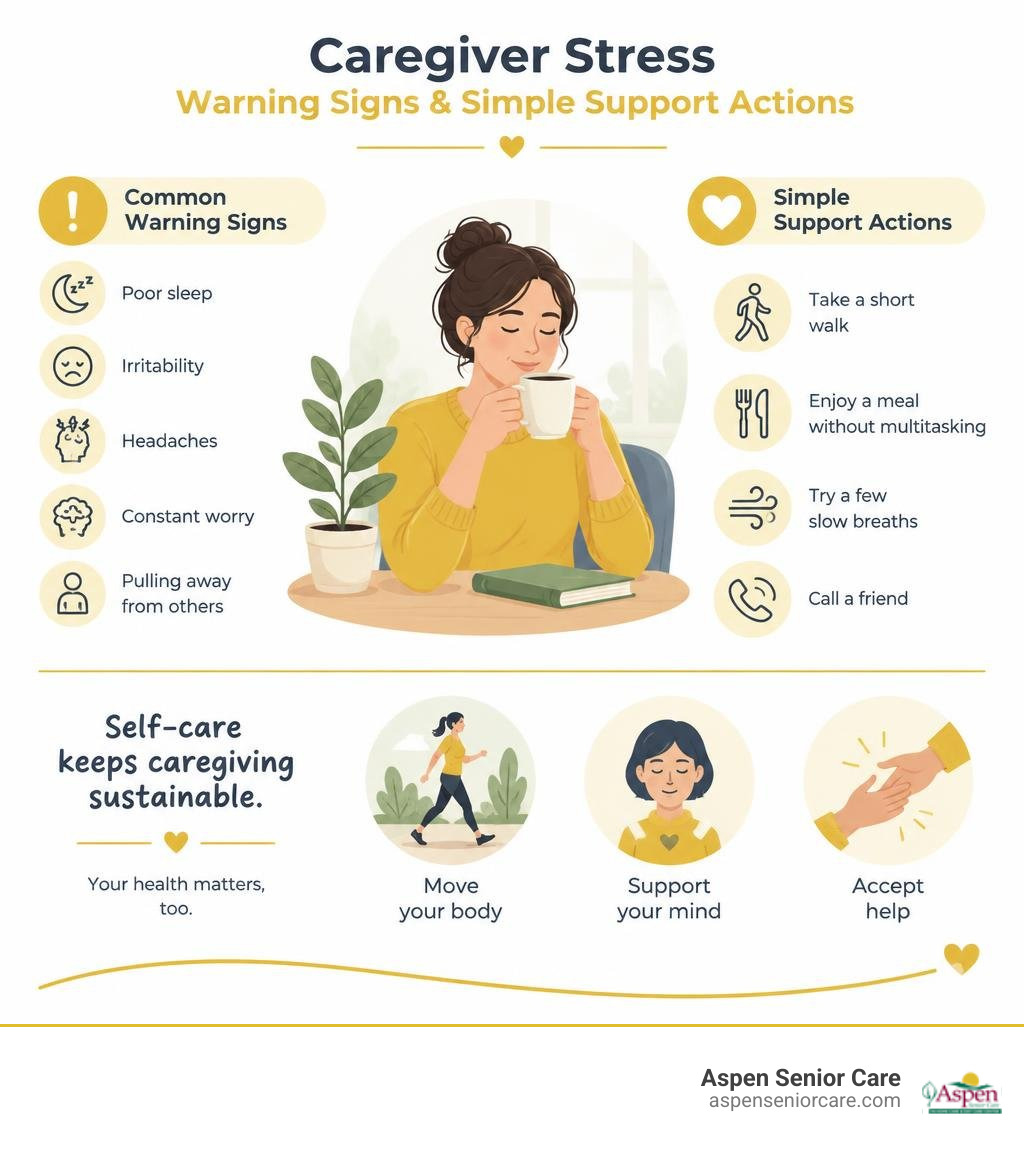
Notice early stress signs such as poor sleep, irritability, headaches, constant worry, or pulling away from others.
Build short breaks into each day - a walk, a meal without multitasking, a few slow breaths, or time to call a friend.
Ask for one specific kind of help this week, such as a grocery run, medication pickup, meal delivery, or coverage for an appointment.
For adult children balancing work, family life, and an aging parent's needs at home, caregiving can become a nonstop set of decisions. Medication schedules, safety concerns, appointments, and daily tasks add up quickly. Ignoring your own needs can make stress harder to manage and can affect the steady, compassionate care you want to give.
Self-care is not a reward for finishing everything. It is what helps make caregiving sustainable.
The Hidden Cost of Caregiving: Physical, Mental, and Emotional Toll
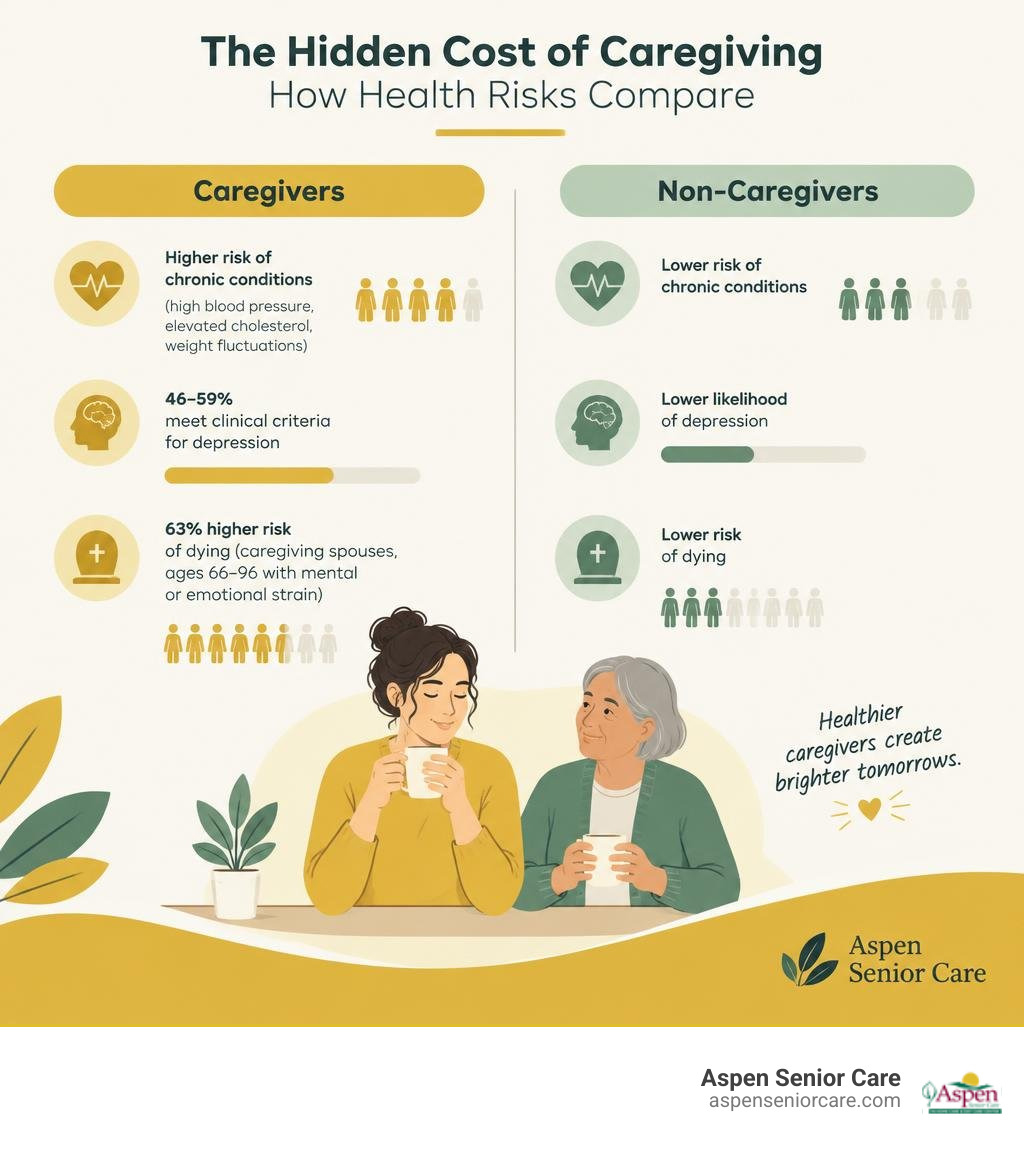
When you step up to support an aging parent or spouse, you do it out of deep love and devotion. Yet, family caregiving often carries an invisible price tag. Across the nation, an estimated 63 million Americans are providing unpaid care to loved ones. While the experience brings moments of profound connection, the constant physical and emotional strain can quietly erode your own health.
Caregivers are significantly more likely than non-caregivers to develop chronic conditions, including high blood pressure, elevated cholesterol, and weight fluctuations. Furthermore, between 46 percent and 59 percent of caregivers meet the clinical criteria for depression. Perhaps most sobering of all, scientific research on caregiver mortality and strain reveals that caregiving spouses between the ages of 66 and 96 experiencing mental or emotional strain face a 63 percent higher risk of dying than non-caregivers in their same age bracket.
When we give everything to another person without replenishing our own physical reserves, our bodies eventually force us to stop. As outlined in clinical guidance on caregiver stress prevention, chronic caregiver stress suppresses the immune system, leaving you vulnerable to systemic inflammation, frequent infections, and prolonged illness.
Recognizing Signs of Caregiver Stress and Burnout
Burnout does not appear overnight; it creeps in through small, daily compromises. You might skip your morning walk to fold laundry, cancel your own dental cleaning to drive to a specialist, or rely on sugary snacks to get through an exhausting afternoon.
Over time, this chronic overwhelm blossoms into distinct physical and psychological warning signs:
Emotional Depletion: Feeling completely numb, hollow, or unable to summon empathy when your loved one calls your name.
Sleep Disruptions: Lying awake at night anticipating nighttime wandering or waking up exhausted despite spending hours in bed.
Short Fuse and Irritability: Snapping at family members, feeling resentful toward siblings who live out of state, or losing patience over minor setbacks.
Somatic Complaints: Frequent tension headaches, digestive issues, chronic back pain from lifting, or sudden changes in appetite.
Social Withdrawal: Pulling away from friends, skipping church or community events, and feeling as though nobody truly understands what your daily life feels like.
The Clinical and Medical Demands on Family Members
Today's family caregivers are not just preparing meals and helping with laundry; they are effectively managing complex home healthcare environments. Approximately 37 percent of family caregivers administer complex medications, give injections, manage feeding tubes, or handle wound care.
Even more challenging, 77 percent of caregivers handling medical tasks report needing outside advice and guidance to navigate these responsibilities safely. The fear of making a mistake creates constant healthcare anxiety. In clinical settings, healthcare workers often experience the "second victim phenomenon"—a state of intense emotional trauma and guilt following an adverse patient event or near-miss. Family caregivers experience this exact same trauma at home, but without a debriefing room, administrative backup, or a shift change.
Caring for the Care Giver: Essential Self-Care and Health Strategies

Every time you board an airplane, the flight attendant delivers the classic safety instruction: put on your own oxygen mask before assisting others. In caregiving, this isn't just a metaphor—it is a physiological reality. If you pass out from lack of oxygen, neither you nor your loved one survives.
Prioritizing your own well-being is not selfish; it is the cornerstone of sustainable care. Our caregiver support guide 2026 emphasizes that caring for your body directly enhances the safety, patience, and warmth you bring to your loved one.
According to the National Institute on Aging caregiver self-care guide, maintaining your health requires establishing non-negotiable baselines:
Protecting 7 to 9 Hours of Sleep: Sleep is the brain's waste-clearance system. Without adequate rest, emotional regulation plummets.
Scheduling Preventive Health Checkups: Keep your own mammograms, blood pressure checks, and dental visits on the calendar.
Fueling with Whole Foods: Keep pre-cut vegetables, nuts, and easy protein options ready so you aren't living on leftover crackers and cold coffee.
Moving Daily: Even a 15-minute walk around the block releases endorphins and reduces cortisol.
Daily Micro-Habits for Caring for the Care Giver
You do not need a three-hour spa day to reset your nervous system. In fact, tiny, consistent micro-habits throughout the day are far more effective at regulating chronic stress.
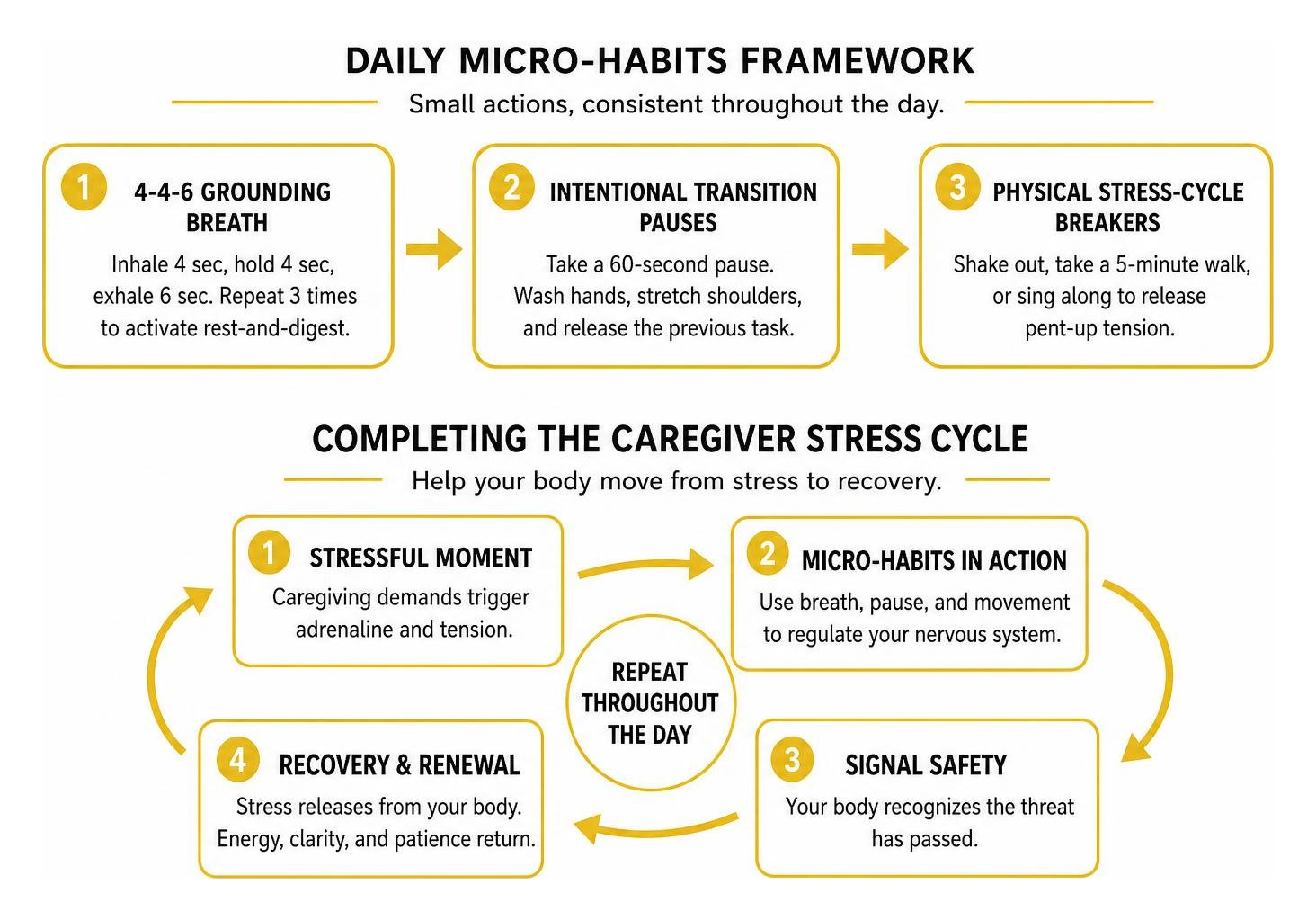
As highlighted in the evidence-based workbook on steps to caregiver well-being, our bodies need help completing the "stress cycle." When stressful moments arise, your body floods with adrenaline. If you don't signal to your body that the threat has passed, that stress stays trapped in your muscles.
Try these simple tools during your daily routine:
The 4-4-6 Grounding Breath: Inhale through your nose for 4 seconds, hold for 4 seconds, and exhale slowly through your mouth for 6 seconds. Doing this three times shifts your autonomic nervous system from "fight-or-flight" into "rest-and-digest."
Intentional Transition Pauses: Before moving from your caregiving duties to cooking dinner or greeting your spouse, take a 60-second transition pause. Wash your hands with warm water, stretch your shoulders, and consciously release the previous task.
Physical Stress-Cycle Breakers: Shake out your hands, take a brisk 5-minute walk around the yard, or put on a favorite song and sing along to discharge pent-up physical tension.
Communicating Effectively with Healthcare Providers
Navigating appointments with doctors, physical therapists, and specialists can feel overwhelming. You have limited time in the exam room, and important details often slip through the cracks.
To make the most of every clinical visit:
Keep a Running Log: Use a notebook or smartphone app to record changes in appetite, mood swings, bathroom habits, or mobility over the previous two weeks.
Bring a Prioritized Question List: Write down your top three concerns at the top of the page. Doctors appreciate clear agendas.
Use Clear "I" Statements: Instead of saying, "Mom is impossible in the afternoons," frame the observation clearly: "I notice that her confusion and agitation spike around 4:00 PM, and I need strategies to keep her calm and safe."
Mention Your Own Caregiver Role: Inform the physician that you are the primary caregiver. Doctors can provide community referrals, order physical therapy assessments, and evaluate whether current medications are overly complicated to manage at home.
How Family, Friends, and Communities Can Step In

Caregiving should never be an individual sport. Yet, many family members hesitate to reach out because they don't want to burden their circle. Meanwhile, friends and extended family members often genuinely want to help, but they stay quiet because they simply don't know what to do.
Research highlighted in a Psychology Today study on caregiving and relationship resilience reveals that social connectedness acts as a powerful buffer against caregiver depression. Caregivers who maintain open social ties and accept regular community assistance experience significantly lower rates of burnout and emotional fatigue.
Practical Ways of Caring for the Care Giver as Friends and Family
If you are a friend, neighbor, or family member looking to support a caregiver, avoid saying, "Let me know if you need anything!" That well-meaning phrase puts the mental burden back on the exhausted caregiver to figure out a task, coordinate a schedule, and reach out.
Instead, offer concrete, low-pressure support:
Drop Off Specific Meals: "I made a double batch of lasagna in a disposable pan. Can I drop it by your porch on Tuesday around 5:00 PM?"
Batch Household Errands: "I'm heading to Costco and the pharmacy this morning. Send me your list of staples, paper goods, or prescriptions and I'll drop them off."
Tackle Yard Work and Chores: Show up to mow the lawn, rake leaves, shovel snow, or take the family dog for a long walk.
Provide Compassionate Listening: Spend 30 minutes listening to the caregiver talk about their feelings without offering unsolicited medical advice or trying to "fix" unfixable situations.
Keep Inviting Them: Even if they decline social outings due to caregiving duties, keep sending texts, invitations, and thinking-of-you notes. Feeling remembered prevents deep isolation.
Overcoming Guilt: How to Ask for and Accept Help
Many caregivers struggle with internal guilt, believing they should be able to handle everything alone. This negative self-talk—"Nobody can care for Mom as well as I do," or "It's my duty as a child to do this without complaining"—is one of the fastest paths to emotional exhaustion.
Learning to delegate is a skill that protects your loved one's long-term care. Start small:
Create a Master Task List: Divide your daily responsibilities into tasks only you can do (medical decision-making, direct comfort) and tasks anyone can do (lawn care, grocery runs, vacuuming, picking up prescriptions).
Assign Specific Tasks to Volunteers: When someone asks how they can help, hand them an item from your list.
Connect with Peers: Joining caregiver support groups allows you to connect with others who understand the unique dynamics of caring for aging parents. Hearing other caregivers talk about their boundaries makes it much easier to release unnecessary guilt. If you are searching for local groups in Utah County, exploring elder care support groups near me can help you find weekly and monthly peer meetings in Orem, Provo, and surrounding areas.
Utilizing Professional Support and Respite Care Options
Even with the most supportive network of friends and family, there comes a point where professional respite care becomes essential. Professional respite provides temporary, high-quality care for your loved one, giving you the time and space to recharge, manage your career, attend to your own health, or simply rest.
At Aspen Senior Care, we work with families across Utah Valley—including Orem, Provo, Lehi, American Fork, Pleasant Grove, Spanish Fork, Alpine, Cedar Hills, Salem, Eagle Mountain, Highland, Lindon, Saratoga Springs, and Payson. We believe that professional support is not a sign of giving up; it is an intelligent, compassionate strategy that keeps families together and healthy.
Whether you need a few hours of support each week or dedicated in-home respite care services, professional caregivers can assist with personal care, meal preparation, medication reminders, and companionship. For families navigating memory loss, our specialized respite care for dementia carers ensures your loved one receives stimulating, dignified cognitive support while you take time to care for yourself.
Adult Day Programs and Structured Support
For many caregivers, adult day care programs offer the ideal balance of socialization, structured cognitive stimulation, and respite. Instead of remaining isolated at home, seniors spend their day in a secure, vibrant community enjoying music, crafts, gentle exercise, and wholesome meals under professional supervision.
Here is a quick look at how different respite care options compare:
Respite Care Option | Primary Benefits | Best Suited For | Typical Schedule |
|---|---|---|---|
Adult Day Care Center | Cognitive games, peer socialization, group activities, active supervision, and caregiver workday relief | Seniors wanting social connection; caregivers working daytime hours or needing dedicated personal time | Half-day or full-day sessions (e.g., 8:00 AM – 5:00 PM) |
In-Home Respite Care | 1-on-1 personalized non-medical care, familiar home environment, routine assistance, and meal prep | Seniors with mobility limits; caregivers who need flexible hourly assistance at home | A few hours per week up to 24/7 continuous coverage |
Overnight Respite Care | Safe overnight monitoring, sleep assistance, medication schedules, and emergency support | Caregivers traveling, attending out-of-town events, or needing uninterrupted nighttime sleep | Single nights, weekends, or extended weekly stays |
Enrolling your loved one in a community day respite centre allows them to make new friends and stay mentally engaged. Families frequently discover that using day respite services for seniors reduces nighttime agitation and sundowning at home, making evenings much more peaceful for everyone.
Flexible In-Home and Overnight Care Options
Every family's routine is different. Some adult children need coverage for a few hours on Thursday mornings to attend their own doctor appointments and run errands. Others need planned overnight respite care so they can attend a child's out-of-town graduation or simply catch up on uninterrupted sleep.
For families living in Utah County, accessing reliable Orem Utah caregiver respite options gives you peace of mind knowing that skilled, background-checked, and compassionate professionals are caring for your parent right at home.

Frequently Asked Questions About Caregiver Wellness
Why do caregivers experience higher health risks than non-caregivers?
Caregivers face higher health risks because chronic caregiving triggers sustained elevations in stress hormones like cortisol and adrenaline. Over months and years, this constant nervous system activation increases blood pressure, promotes cardiovascular strain, and weakens immune function.
Additionally, caregivers frequently put off their own preventive healthcare appointments, skip exercise routines, experience broken sleep, and rely on quick, processed meals. This combination of elevated biological stress and neglected self-care creates a compounding health burden.
How can I ask family members for help without feeling guilty?
The easiest way to ask for help without guilt is to be direct, practical, and specific. Instead of making an open-ended request like "I need more help with Dad," identify concrete tasks that match your family members' schedules and skills.
For instance, you might say: "I am managing Dad's daily medications and doctor appointments, but I need help with grocery shopping and lawn care. Can you take over ordering his groceries on Sundays, or cover two hours on Saturday afternoon so I can leave the house?" Breaking responsibilities into clear, actionable pieces removes ambiguity and gives others a straightforward way to contribute.
What should I do immediately if I feel on the verge of caregiver burnout?
If you feel completely overwhelmed and on the verge of emotional or physical collapse, take immediate action:
Secure Immediate Respite: Reach out to a family member, neighbor, or professional in-home care agency to step in for an afternoon or a weekend so you can step away and rest.
Consult Your Primary Care Physician: Schedule an appointment with your doctor and be completely honest about your stress, sleep issues, and mood. Your physician can evaluate you for depression, monitor your vitals, and provide medical guidance.
Contact a Support Group: Connecting with other caregivers through a local or virtual peer group validates your feelings and reminds you that you are not failing—you are simply carrying a heavy load that requires shared support.
Conclusion
Caring for an aging parent or loved one is a journey filled with deep love, shared memories, and quiet acts of devotion. But it should never require the sacrifice of your own physical health, emotional vitality, or peace of mind.
By learning to recognize the early signs of stress, practicing daily grounding micro-habits, accepting help from your community, and partnering with experienced professional caregivers, you create a sustainable rhythm that supports both you and your loved one.
At Aspen Senior Care, we are committed to walking alongside Utah Valley families every step of the way. Whether you need in-home caregiving support, specialized dementia care, or a vibrant day program for your aging parent, our award-winning team provides compassionate, family-like non-medical care. Explore our comprehensive collection of supportive care-giver resources and personalized assistance to find the practical help and relief your family deserves today.