

How Senior Daycare Services Benefit Older Adults and Caregivers
When Caring for a Parent Feels Overwhelming, Senior Daycare Services Can Help
Senior daycare services give older adults a safe, structured place to spend the day — while giving family caregivers the time and space they need to breathe.
Here's a quick overview of what they offer:
What they are: Community-based programs where seniors receive meals, activities, health monitoring, and social interaction during daytime hours
Who they're for: Older adults who need supervision or support but don't require round-the-clock residential care
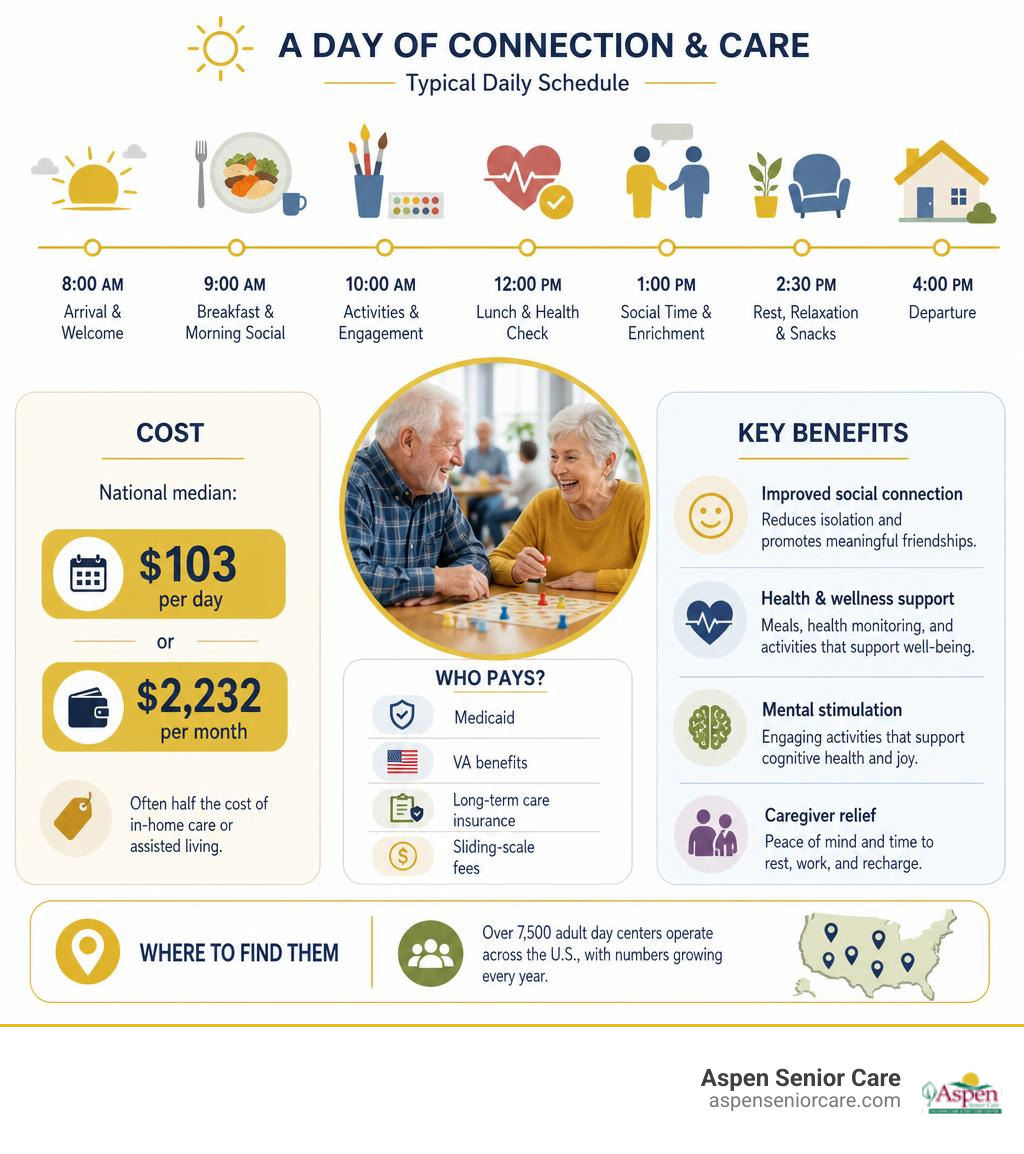
Cost: The national median is around $103 per day or $2,232 per month in 2025 — often half the cost of in-home care or assisted living
Who pays: Medicaid, VA benefits, long-term care insurance, and sliding-scale fees are all common options
Where to find them: Over 7,500 adult day centers operate across the U.S., with numbers growing every year
If you're an adult child in Utah Valley trying to hold down a job while also keeping a parent safe at home, you're not alone. Millions of family caregivers face this same juggling act every day.
The worry is real. Will Mom be okay while I'm at work? Is Dad getting enough social interaction? Am I burning out?
Senior daycare programs were built to answer exactly those questions — by providing structured, supportive care during the day so seniors stay engaged, healthy, and safe, and so caregivers can actually rest.
What Are Senior Daycare Services and How Do They Work?

To put it simply, senior daycare services (often called adult day centers) provide a secure, lively environment for older adults who need assistance or supervision during the day. These programs are designed to fill the gap between fully independent living and 24-hour residential care.
But how do they differ from other options you might be considering?
Senior Centers vs. Adult Day Care: A traditional senior center is geared toward highly independent older adults who drop in for a quick lunch, a game of bridge, or a community class. Adult day care, on the other hand, is highly structured and designed for seniors with physical limitations or cognitive decline who cannot safely be left alone.
Assisted Living vs. Adult Day Care: Assisted living is a residential solution where seniors live full-time. Adult day care allows your loved one to receive professional care and social stimulation during the day, but return to the comfort of their own home every evening.
In-Home Care vs. Adult Day Care: While in-home care brings a professional caregiver into your house, our community-based Adult Day Care Services bring seniors into a group setting. This offers a level of peer-to-peer socialization that is incredibly difficult to replicate at home.
Today, there are more than 7,500 adult day care facilities operating throughout the United States, serving over 250,000 participants. The average age of an adult day care participant falls between 77 and 79 years old. Because more than half of all attendees have some form of cognitive impairment, these centers are uniquely equipped to handle complex memory care needs in a safe, compassionate environment.
Primary Types of Day Programs
Not all adult day centers are identical. Depending on your loved one's physical and mental health, you will generally choose between three primary models:
The Social Model: These programs focus heavily on peer interaction, recreational activities, nutritious meals, and basic wellness recreation. They are ideal for seniors who are physically healthy but lonely, isolated, or experiencing mild cognitive changes.
The Medical/Health Model: In addition to social activities, these licensed programs provide intensive health services. If your loved one requires physical therapy, wound care, or regular monitoring by a registered nurse, a medical model center ensures their health needs are met while you are at work.
Specialized Memory Care: These programs are specifically tailored for individuals living with moderate to advanced stages of dementia, Alzheimer's, or Parkinson's disease. The environment is secured to prevent wandering, the staff-to-client ratio is highly focused, and activities are structured to support cognitive preservation. If your family is navigating these diagnoses, exploring Adult Day Care for Dementia or specialized Adult Day Care for Parkinsons can provide a profound sense of relief.
Key Services Provided by Senior Daycare Services
What does a typical day look like for a participant? While every center operates slightly differently, high-quality programs offer a well-rounded suite of daily services:
Medication Reminders and Administration: Trained staff members monitor and document daily medications, ensuring your loved one never misses a dose.
Gentle Exercise and Mobility Support: From chair yoga and guided walking paths to fun balloon volleyball games, physical activities are modified to match each senior's unique physical abilities.
Nutritional Meals and Snacks: Centers typically provide hot, balanced meals and healthy snacks throughout the day, accommodating specific dietary restrictions.
Transportation Logistics: Many families struggle with the logistics of drop-off and pick-up. Fortunately, reliable transportation can often be arranged to shuttle seniors safely to and from the facility.
Recreational and Cognitive Activities: Days are packed with memory-stimulating games, music therapy, arts and crafts, and lively group discussions of current events to keep minds active and bodies moving.
The Dual Benefits of Day Programs for Older Adults and Caregivers

It is easy to think of senior daycare as a service designed solely for the person attending. In reality, it is a dual-benefit system that breathes new life into the entire family unit.
For the older adult, the benefits are immediate and measurable:
Combating Isolation: Loneliness is a silent epidemic among seniors, often contributing to rapid cognitive decline and depression. A day center provides an instant community of peers.
Cognitive and Physical Stimulation: Rather than spending the day sleeping on the couch or watching television, seniors participate in structured activities that preserve hand-eye coordination, physical mobility, and mental sharpness.
Improved Sleep Patterns: A fascinating 2021 study revealed that both dementia patients and their family caregivers experienced significantly better, deeper sleep with fewer nighttime disturbances on the nights following a day care session. When seniors are physically and mentally active during the day, their biological clocks naturally reset.
For the family caregiver, the benefits are equally life-changing:
True Respite Care: Caregiving is one of the most rewarding yet exhausting jobs in the world. Having a reliable block of hours during the day allows you to run errands, attend your own medical appointments, or simply rest.
Burnout Prevention: Constant supervision can strain family relationships. Stepping away for a few hours allows you to return to your caregiving role with renewed patience, energy, and love.
The Ability to Work: For many adult children, leaving a career to provide full-time care is not financially feasible. Senior daycare provides a safe, reliable alternative that allows you to maintain your employment and financial stability.
Analyzing the Costs and Funding Options for Care
One of the most appealing aspects of senior daycare services is their affordability compared to other long-term care options. On average, adult day care costs about half as much as hiring an in-home care aide or transitioning a loved one into an assisted living community.
To help you visualize the financial landscape, here is a breakdown of how adult day care costs compare to other senior care solutions:
Care Option Estimated Cost Structure Average Monthly Cost Adult Day Care $78 to $103 per day $1,690 to $2,232 / month In-Home Care (40 hrs/week) $25 to $35 per hour $4,000 to $5,600 / month Assisted Living Community Flat monthly residential fee $4,500 to $6,000+ / month
Note: National median cost estimates are based on 2025 and 2026 data projections. Local Utah County rates may vary based on the level of specialized medical or memory care required.
When it comes to paying for these services, families have several avenues to explore:
Medicaid: In many states, including Utah, Medicaid waivers may cover some or all of the costs of adult day services for seniors who meet low-income and clinical eligibility criteria.
Veterans Benefits (VA): The VA frequently covers adult day health care services for eligible veterans or their surviving spouses through the Community Care program.
Long-Term Care Insurance: If your loved one has a private long-term care insurance policy, review the terms — many policies include coverage for licensed adult day care programs.
Sliding-Scale Fees: Some non-profit or community-based centers offer sliding-scale fees based entirely on the senior's monthly income and assets.
How to Evaluate and Choose the Right Center
Choosing where your loved one will spend their days is a deeply personal decision. You want to ensure the environment is safe, the staff is compassionate, and the atmosphere feels like home.
When researching local options, the first detail to look at is the staff-to-client ratio. While state regulations vary, look for facilities that prioritize small-group dynamics. For instance, a 4:1 client-to-caregiver ratio ensures that your loved one will never feel lost in the crowd and will receive the individual attention, safety monitoring, and personal connection they deserve.
Additionally, verify that the facility is fully licensed by the state and that the Adult Day Care Team undergoes rigorous background screening, CPR certification, and continuous training in dementia care and behavior management.
How to Choose the Best Senior Daycare Services for Your Family
To begin your search, start by gathering a list of local providers. Excellent starting points include the federal Eldercare Locator tool or your local Area Agency on Aging.
Once you have a shortlist, schedule in-person tours. While walking through each facility, keep this checklist in mind:
[ ] Cleanliness and Safety: Is the facility clean, bright, and free of unpleasant odors? Are there secure outdoor walking paths and grab bars in the restrooms?
[ ] Atmosphere: Do the participants look happy and engaged? Is the environment calm, or does it feel chaotic?
[ ] Emergency Protocols: What is the center's plan for medical emergencies? How do they handle wandering or exit-seeking behaviors?
[ ] Staff Interaction: Does the staff speak to seniors with dignity, patience, and respect? Are they actively participating in activities with the clients?
[ ] Nutritional Quality: Ask to see a monthly menu. If possible, sample a meal to ensure the food is fresh, healthy, and appetizing.
Helping Your Loved One Transition and Adjust
It is incredibly common for seniors — especially those experiencing cognitive decline — to resist the idea of attending a day program at first. They may feel anxious about meeting new people, or they might view the transition as a loss of independence.
To make the adjustment process as smooth as possible, we recommend a compassionate, gradual approach:
Avoid the Word "Daycare": Many older adults find the term patronizing. Instead, refer to the center as "the club," "the senior community center," or "the activity group."
Start with a Trial Period: Don't jump straight into a full five-day-a-week schedule. Start by sending your loved one just two days a week for a month. Give them time to adapt to the new routine.
Frame Attendance as a "Job" or "Volunteer Role": If Mom or Dad has a strong work ethic, tell them the center needs their help. For example, you might say, "The coordinator needs help with the gardening club today," or "They really need someone with your sewing experience to help out."
Accompany Them Initially: Spend the first 10 to 15 minutes of the first few sessions with your loved one to help them settle in, then gradually slip away once they get involved in an activity.
Be Patient: It typically takes several weeks for a senior, particularly one with dementia, to fully adjust to a new routine. Focus on the positive moments and celebrate small wins.
If you are looking for an award-winning program in Utah Valley that specializes in making this transition feel natural, warm, and family-like, the team at Aspen Senior Day Center in Provo is always here to help you navigate these first steps.
Frequently Asked Questions about Senior Daycare
Who is a good candidate for adult day care?
A great candidate is any older adult who cannot safely be left home alone, experiences loneliness or depression, is unable to structure their own daily activities, or is living with a progressive condition like Alzheimer's, Parkinson's, or physical frailty. It is also an excellent option for seniors living with working family caregivers who need peace of mind during business hours.
Does Medicare cover the cost of senior day programs?
Generally, traditional Medicare (Part A and Part B) does not cover the cost of adult day care services. However, some Medicare Advantage (Part C) plans have begun offering limited adult day care benefits as an extra supplemental service. It is always best to check directly with your specific plan provider.
How long does it take for a senior with dementia to adjust?
On average, it takes about three to four weeks of regular attendance (at least two days per week) for a senior with dementia to settle into the new routine. Consistency is key during this period; skipping weeks or constantly changing days can prolong the adjustment phase.
Conclusion
At Aspen Senior Care, we understand that caring for an aging parent is a journey filled with both beautiful moments and immense challenges. You don't have to carry the weight of caregiving entirely on your own shoulders.
Providing award-winning, family-like, and personalized non-medical care across Utah County — including Orem, Provo, Lehi, American Fork, Pleasant Grove, Spanish Fork, and surrounding areas — our mission is to support both you and your loved one. Whether you are looking for specialized memory care or simply want a vibrant, safe community where your parent can thrive during the day, we are here for you.
Ready to take a breath and explore your options? Contact Us Adult Day Care today to ask questions, or explore our comprehensive Adult Day Care Services to learn how we can help your family find the perfect balance.