

Step-by-Step Guide to Finding Private Duty Care
How to Find the Right Private Duty Care at Home
To find private duty care for an aging parent, start with the help they need each day: bathing, meals, companionship, or someone to check on their safety. Then ask local care providers how they match caregivers, build care plans, and handle schedule changes. If your parent needs medical treatments, ask their doctor whether they also need a licensed nurse.
In Utah Valley, the right support can help your parent keep familiar routines at home while giving your family more room to balance work and caregiving.

Understanding Private Duty Care and In-Home Support
When navigating senior support, understanding your options can sometimes feel like learning a whole new language. Private duty care is a personalized model of one-on-one assistance delivered directly in a client's private home. Unlike standard institutional care or brief medical check-ins, private care is built entirely around an individual’s personal lifestyle, routine, and specific daily needs.
At its core, private duty in-home care offers scheduled hourly blocks or around-the-clock presence to assist older adults with both hands-on personal support and practical daily living tasks. For families seeking a comprehensive overview of how home support functions, our In-Home Care Complete Guide 2026 offers a detailed breakdown.
Service Type | Primary Focus | Best Suited For | Typical Schedule Flexibility |
|---|---|---|---|
Personal Care | Hands-on hygiene, mobility, dressing, bathing, and continence care | Seniors needing direct physical assistance with basic daily functions | 4-hour blocks up to 24/7 continuous coverage |
Companion Care | Social engagement, light housekeeping, meal prep, and safety oversight | Older adults living alone needing friendship, errand help, and reminders | Flexible part-time hours, morning/evening visits |
Adult Day Services | Structured community activities, social interaction, and daytime caregiver respite | Seniors with mild to moderate cognitive changes whose families work during the day | Daytime operational hours on weekdays |
Non-Medical Private Duty Caregiver Support
Non-medical care is provided by compassionate, professional caregivers who assist with non-clinical routines that make independent living possible. Working with vetted private duty in-home caregivers ensures that your loved one has reliable, family-like support without having to alter their daily habits.
These dedicated team members assist directly with Activities of Daily Living (ADLs) and Instrumental Activities of Daily Living (IADLs). Understanding the distinction between IADLs vs ADLs helps families determine the right level of support:
Activities of Daily Living: Essential physical routines such as ADLs assistance, including dignified bathing, dressing, grooming, restroom assistance, and safe transfer support.
Instrumental Activities: Everyday tasks that keep a home running smoothly, such as preparing nutritious meals, managing light housekeeping, organizing personal belongings, and providing vital medication reminders.
Companionship and Socializing: Meaningful conversation, playing board games, going for supervised walks, and engaging in heartfelt companion care for seniors to keep spirits high and reduce isolation.
Who Benefits from Specialized In-Home Support?
In-home care is versatile. It adapts whether someone is facing the natural changes of aging, managing a chronic condition, recovering from surgery, or adjusting to life after a traumatic brain injury (TBI). Having a dedicated professional at home bridges the gap between total independence and institutional care.

Seniors Aging with Cognitive and Neurodegenerative Conditions
Cognitive decline requires patience, structure, and specialized techniques. As conditions like Alzheimer's or other forms of dementia advance, having structured, familiar routines is vital to preventing agitation and confusion.
Our specialized in-home care dementia support focuses on gentle redirection, meaningful memory exercises, and empathetic cognitive support tailored to each stage of memory loss.
Similarly, our practical Parkinsons care guide 2026 highlights the importance of steady mobility assistance, proactive fall prevention, and careful medication timing for neurological conditions. When nighttime wandering or intensive physical needs become a challenge, around-the-clock options like 24 hour dementia care keep seniors secure in their familiar living spaces while family members rest peacefully.
Hospital-to-Home Transitions and Family Support
The transition from a hospital or rehabilitation stay back to everyday home life is a critical window. Without proper support, unexpected falls or medication confusion can lead to a quick trip back to the emergency room.
Caregivers play a vital role during hospital-to-home transitions by keeping living spaces clear of tripping hazards, preparing balanced meals that follow dietary recommendations, and assisting with physical mobility as strength returns.
Equally important is supporting family members who often take on immense physical and emotional burdens. Utilizing planned respite care gives primary family caregivers time to recharge, attend to personal obligations, and protect their own health while knowing their loved one is in safe hands.
Financial Breakdown: Costs, Insurance, and Payment Models
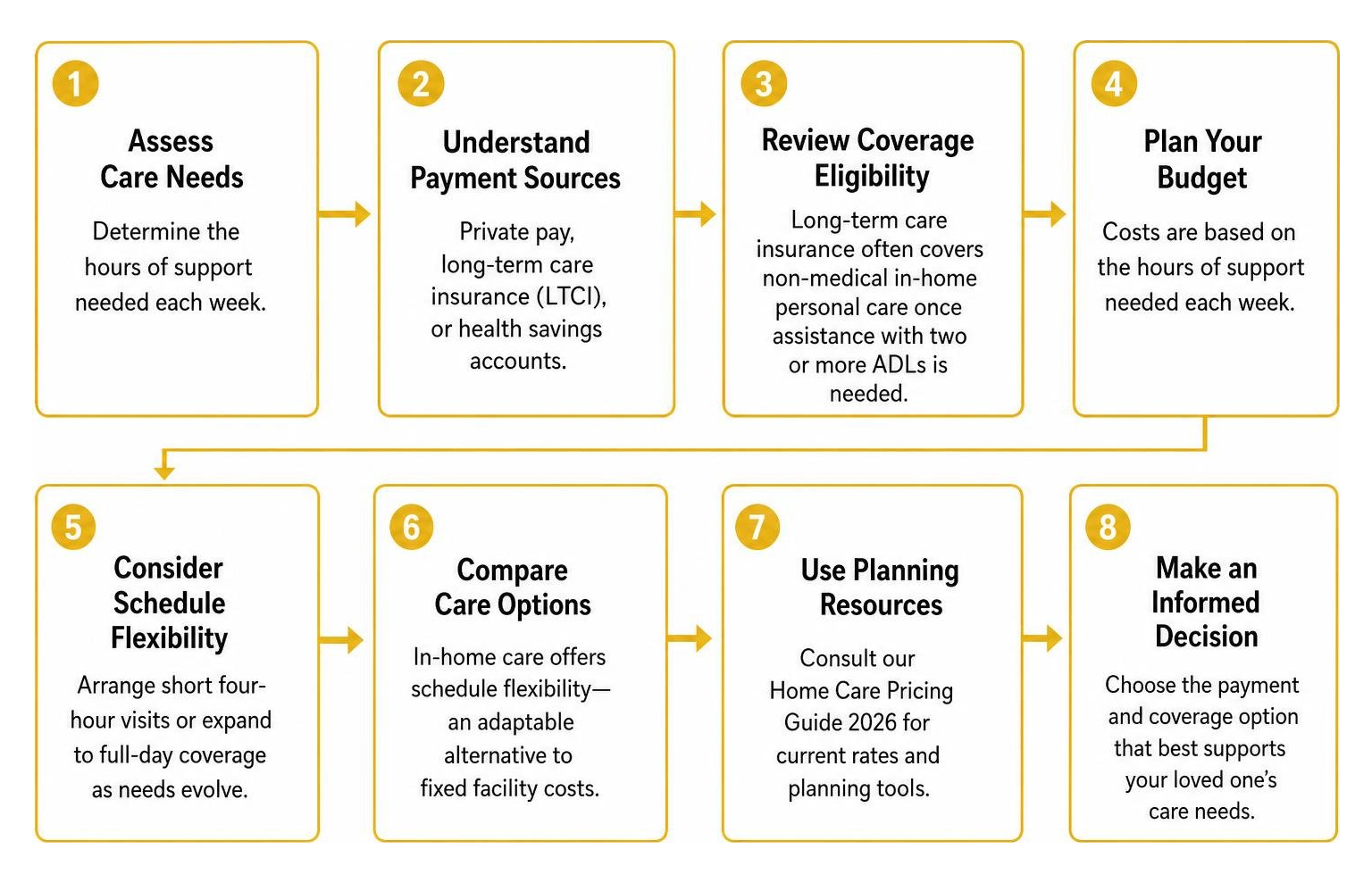
Understanding how in-home care is funded helps families make sustainable, long-term plans. Because non-medical private duty care is customizable, costs are based on the hours of support needed each week.
Budgeting for Private Duty Care and Long-Term Costs
Private duty services are commonly funded out-of-pocket through private pay, long-term care insurance (LTCI), or health savings accounts. For a comprehensive look at current rates and planning tools, consult our Home Care Pricing Guide 2026.
Long-term care insurance policies often cover non-medical in-home personal care once a policyholder requires assistance with two or more ADLs. When planning your budget, in-home care offers schedule flexibility: families can arrange short four-hour visits for morning routines or expand to full-day coverage as care needs evolve, making it an adaptable alternative to fixed facility costs.
Navigating Medicaid, Medicare, and Third-Party Coverage
A common question families ask is whether standard government programs cover everyday in-home care:
Medicare Coverage Boundaries: Medicare is designed for short-term, acute rehabilitation and intermittent skilled clinical needs. Under standard guidelines, Medicare covers part-time skilled services (typically up to 28 hours per week combined, with temporary extensions up to 35 hours) for individuals certified as homebound by a physician. However, Medicare strictly does not pay for 24-hour care or standalone non-medical custodial assistance (such as bathing, dressing, and homemaking) when that is the only care required. If non-covered services are proposed by a clinical provider, an Advance Beneficiary Notice (ABN) is issued to clarify out-of-pocket responsibilities.
Medicaid and Prior Approvals: Medicaid programs often act as payers of last resort after commercial insurance options are exhausted. While state Medicaid programs may provide coverage for specific continuous skilled nursing or personal care programs under strict medical prior approvals, non-medical private duty care is primarily arranged directly by families seeking immediate, flexible, and personalized scheduling without state program delays.
Step-by-Step Process for Choosing the Right Care Agency
Selecting a care partner is one of the most important decisions your family will make. You want a provider that treats your loved one like their own family while maintaining rigorous operational and safety standards.

Here is a straightforward process to guide your selection:
Define Daily Care Needs: List the specific tasks where your parent needs a helping hand, such as morning hygiene, meal planning, afternoon walks, or nighttime safety monitoring.
Request an Initial In-Home Assessment: A qualified care coordinator should meet with your family in the home to evaluate the living environment, understand personal routines, and answer questions.
Confirm Screening and Safety Standards: Verify that all caregivers undergo extensive criminal background checks, motor vehicle record checks, drug screenings, and thorough reference verifications.
Review Caregiver Matching Protocols: Ask how the agency selects caregivers based on personality compatibility, shared interests, and specific experience with conditions like dementia or Parkinson's.
Understand Emergency and After-Hours Support: Ensure the agency has 24/7 office staff available to handle urgent schedule adjustments, illness replacements, or emergency questions.
Evaluating Caregiver Oversight, Credentials, and Consistency
Consistency builds trust. When evaluating providers, ask about caregiver retention and scheduling practices. Having a small, dedicated team of familiar faces prevents confusion for seniors with memory challenges and fosters meaningful friendships.
Look for organizations that maintain active supervisory check-ins, continuous caregiver training, and open communication channels with family members so you are always updated on your loved one’s physical and emotional well-being.
Integrating Complementary Support and Community Care
Great care extends beyond individual shifts at home. Combining in-home caregiving with local community resources creates a well-rounded safety net that supports both the senior and their family network.
For an easy overview of our balanced approach to independent living, take a moment to review our In-Home Care Summary.
Utilizing Adult Day Programs for Daytime Respite
For seniors who enjoy social interaction outside the house, adult day centers provide an enriching daytime experience. Enrolling in daytime adult day services allows older adults to participate in structured games, creative arts, physical exercise, and musical entertainment in a secure setting.
Using day respite services is also a practical way to balance care budgets. Families can combine several days of adult day club attendance with scheduled in-home caregiver visits on other days, giving working family members complete daytime coverage and dependable peace of mind.
Family caregivers can also connect with peers through local caregiver support groups to share advice, gain emotional encouragement, and learn practical tips for managing caregiver fatigue.
Local In-Home Care Coverage in Utah Valley
Finding local care providers who understand your neighborhood ensures fast response times and deep community connections. We proudly provide personalized, award-winning in-home assistance and family respite across Utah Valley, including:
Dedicated in-home care in Orem
Compassionate care teams in Provo
Trusted home support in American Fork
Personalized caregiving across Lehi
Serving families throughout Pleasant Grove, Spanish Fork, Alpine, Cedar Hills, Salem, Eagle Mountain, Highland, Lindon, Saratoga Springs, and Payson.
Frequently Asked Questions About Private Duty Care
What is the difference between private duty care and Medicare-covered home visits?
Medicare-covered home health visits are strictly short-term, intermittent visits ordered by a doctor to treat a specific medical condition or support post-hospital rehabilitation. These clinical visits usually last less than an hour. In contrast, non-medical private duty care provides flexible, continuous blocks of time (from several hours up to 24/7 care) focused on everyday living assistance, personal hygiene, companionship, and household support.
Does Medicare pay for 24-hour private duty care at home?
No. Standard Medicare and Medicare Advantage plans do not pay for 24-hour continuous care, meal preparation, or non-medical custodial care when that is the only assistance required. Families fund continuous private duty care through private pay, long-term care insurance policies, or specialized state-specific assistance programs.
How do I know what level of caregiver support my loved one needs?
The best way to determine the right level of support is through a professional in-home assessment. If your parent is managing well with basic chores but feels lonely or misses meals, companionship and meal prep visits may be sufficient. If they have difficulty getting in and out of the shower safely, need help with dressing, or show signs of wandering due to memory changes, personal care and closer supervision are recommended.
Conclusion
Finding the right care for an aging family member is an act of love. Whether your parent needs occasional morning help with daily routines, compassionate companionship, or specialized around-the-clock support for memory loss, personalized in-home care allows them to stay in the home they cherish with safety and dignity.
At Aspen Senior Care, we are committed to providing award-winning, family-like care tailored to the unique rhythms of your household. Reach out to our compassionate team today through the Aspen Senior Care Home Page to schedule an in-home consultation and discover how we can support your family's caregiving journey.