

The Definitive Guide to Comparing Home Care Costs
What Home Care Prices Really Cost in 2026
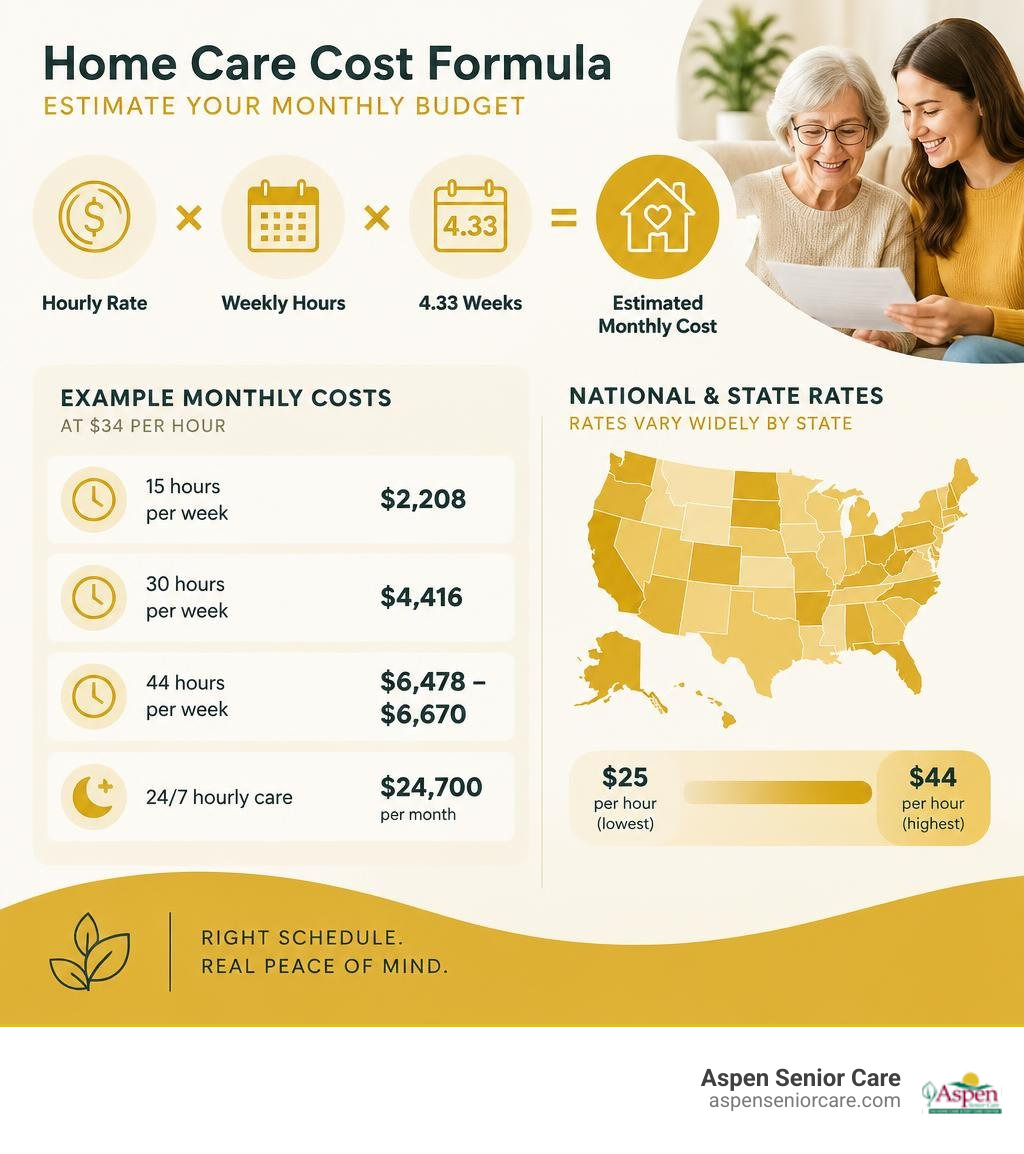
In 2026, the national median home care price for non-medical help is about $34 to $35 per hour. To estimate a monthly budget, multiply the hourly rate by the hours needed each week, then multiply by 4.33.
Care schedule | Estimated monthly cost at $34/hour |
|---|---|
15 hours per week | $2,208 |
30 hours per week | $4,416 |
44 hours per week | about $6,478 to $6,670 |
24/7 hourly care | about $24,700 per month |
For Utah Valley families balancing jobs, children, and an aging parent's safety at home, the most important number is not the national median. It is the cost of the right schedule in your local area.
Rates vary widely by state, from roughly $25 per hour in Mississippi to $44 per hour in South Dakota. The type of help also matters. Companion care and personal care usually cost less than skilled nursing, while dementia support, overnight coverage, weekends, and short shifts can raise the price.
This guide explains how to compare quotes, calculate the full monthly cost, understand what Medicare and Medicaid may cover, and decide when home care remains the best value compared with adult day care or senior living.
Understanding the 2026 National Home Care Price and State Variations

When planning care for an aging parent, looking at national figures provides a helpful baseline. Nationwide, non-medical in-home care rates have risen steadily, climbing roughly 3% over the past year to land at a median of $34 to $35 per hour. For families who need full-time coverage (defined by industry surveys as 44 hours per week), this equates to an annual commitment of roughly $80,080.
However, direct-care labor markets and regional living costs create significant divergence across the country. In our experience serving families across Orem, Provo, Lehi, American Fork, and surrounding Utah County communities, local pricing reflects specific regional dynamics such as caregiver wage competition and local economic growth. Reviewing 2026 in-home care pricing data shows how schedules and regional labor pools dramatically influence what families actually spend. To build a solid foundation, exploring our comprehensive overview of in-home care can help clarify what services fit into these cost structures.
Hourly Rates and Monthly Cost Formulas
Because months do not divide evenly into four weeks, budgeting requires a standard calculation:
$$\text{Monthly Cost} = \text{Hourly Rate} \times \text{Weekly Hours} \times 4.33$$
Here is how typical weekly schedules translate into monthly budgets based on a $35/hour baseline:
10 Hours per Week (Light Companion Support): $1,515.50 per month
20 Hours per Week (Part-Time Daily Assistance): $3,031.00 per month
30 Hours per Week (Comprehensive Daytime Help): $4,546.50 per month
44 Hours per Week (Full-Time Standard Benchmark): $6,668.20 per month
Many agencies also implement shift minimums (typically 3 to 4 hours per visit). A family needing only one hour of help in the morning may still be billed for the three-hour minimum, which alters the effective hourly rate. Detailed national home care cost analysis demonstrates why understanding these structural rules prevents unexpected monthly invoices.
High-Cost vs. Low-Cost States
State-by-state variations are substantial:
Least Expensive: Mississippi averages approximately $25 per hour ($4,576 monthly for 44 hours/week).
Most Expensive: South Dakota averages approximately $44 per hour ($8,380 monthly for 44 hours/week).
Mountain West & Utah: Utah typically aligns closely with the national median at approximately $34 to $35 per hour.
These disparities stem from state-mandated training requirements, workers' compensation insurance rates, caregiver supply shortages, and broader cost-of-living differences.
Care Level Breakdown: Non-Medical Home Care and Specialized Support
The type of support required is the primary driver of pricing tiers. Home-based senior care generally falls into three categories:
Companion Care: Social engagement, meal preparation, light housekeeping, and running errands. Check our transparent companion care pricing for detailed service expectations.
Personal Care (Hands-On): Assistance with Activities of Daily Living (ADLs) such as bathing, dressing, grooming, toileting, and transfer assistance.
Skilled Nursing / Home Health Care: Clinical medical tasks managed by licensed practical nurses (LPNs) or registered nurses (RNs), such as complex wound care, tube feeding, and intravenous medications. While non-medical care medians sit around $34 to $35 per hour, private duty nursing averages $90 per hour nationally, with RN rates ranging from $85 to $110+ per hour.

Factors That Increase Your Base Home Care Price
When requesting quotes, several clinical and scheduling factors can introduce rate differentials:
Specialized Memory Care: Caring for seniors with advanced Alzheimer's disease or other dementias requires specialized behavioral training and safety oversight, often adding a $2 to $5 per hour differential.
Two-Person Transfers: When a senior cannot bear weight and requires two caregivers to safely transfer from bed to wheelchair, the hourly billing rate doubles for those hours.
Overnight and Weekend Shifts: Active (awake) overnight shifts or weekend coverage frequently carry a $2 to $4 per hour premium.
Short-Shift Markups: Visits under three hours often carry a higher base rate to cover caregiver travel and dispatch costs.
Agency Care vs. Direct Hire: Weighing Cost Against Risk

Families often debate between hiring an independent caregiver directly or partnering with a licensed home care agency.
Comparing Agency Rates to an Independent Home Care Price
Independent caregivers typically charge $20 to $27 per hour, which looks attractive compared to agency rates of $34 to $35 per hour. However, direct hiring shifts substantial administrative and legal responsibilities onto the family:
Consideration | Licensed Home Care Agency | Direct Private Hire |
|---|---|---|
Hourly Rate | $34 – $38 / hr | $20 – $27 / hr |
Taxes & Payroll | Handled by agency (W-2, FICA, FUTA) | Family must file household employer taxes |
Workers' Comp | Agency carries full insurance | Family liable for on-the-job injuries |
Background Checks | Multi-state background & reference checks | Family must conduct and pay for vetting |
Backup Care | Guaranteed replacement when staff calls out | Family must provide backup coverage |
Training & Oversight | Ongoing training and nurse supervision | Family provides all training and management |
Agency rates include caregiver wages plus payroll taxes, general liability insurance, workers' compensation, bonded coverage, supervisory visits, and continuing education. For a detailed breakdown of how managed services protect families, review our summary of in-home care services.
Schedule Models: Part-Time, 24/7, and Live-In Care
When seniors require around-the-clock supervision, two primary models exist:
Continuous 24/7 Hourly Shifts: Multiple caregivers rotate across 8- or 12-hour awake shifts throughout the 168-hour week. At $34/hour, this equals roughly $5,712 per week or $24,733 per month.
Live-In Care: A single primary caregiver resides in the home, working an active 8-to-10-hour day while sleeping on-site at night (the client must provide a private room and uninterrupted sleep). Live-in care typically costs a flat daily rate between $300 and $450 per day ($9,000 to $13,500 monthly), offering substantial savings over hourly 24/7 care when the client's nighttime needs are minimal.
In-Home Care and Adult Day Care Costs
When evaluating care costs, comparing in-home support with adult day centers, assisted living, and nursing facilities helps contextualize your options:
Care Setting | Typical Schedule | Median Monthly Cost (2026) | Annual Cost |
|---|---|---|---|
In-Home Care (Part-Time) | 20 hrs/week | $3,031 | $36,372 |
In-Home Care (Full-Time) | 44 hrs/week | $6,668 | $80,080 |
In-Home Care (24/7 Awake) | 168 hrs/week | $24,733 | $296,796 |
Adult Day Care | 5 days/week (daytime) | $2,058 ($95/day) | $24,700 |
Assisted Living Facility | Full-time residential | $6,200 | $74,400 |
Nursing Home (Private Room) | Full-time skilled care | $10,798 | $129,575 |
Integrating Community Programs and Adult Day Care
For seniors living in Utah County (including Orem, Provo, Pleasant Grove, Spanish Fork, Lindon, and Payson), combining part-time in-home care with adult day programs is one of the most effective ways to balance cost and care quality.
Sending a loved one to an adult day center two or three days a week provides essential social stimulation, activities, and meals at a fraction of one-on-one hourly rates, while in-home caregivers cover mornings, evenings, or weekends. To see how these programs fit your financial plan, compare our adult day care pricing options and review typical adult day care costs.
Coverage, Insurance, and Financial Assistance Programs
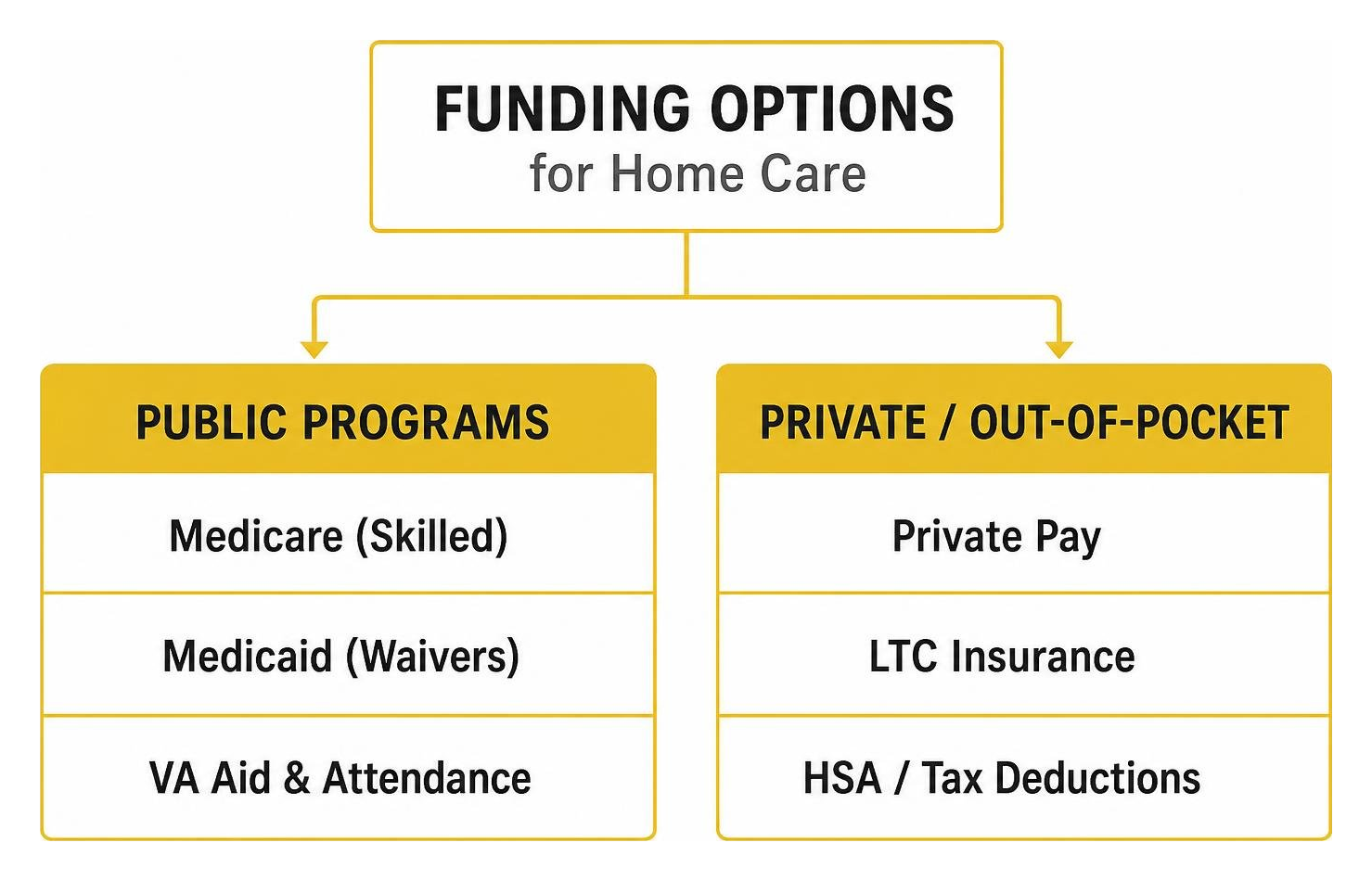
Understanding which funding sources cover home care helps protect family savings:
What Medicare and Medicaid Actually Pay
Medicare: Medicare does not pay for non-medical custodial care (such as help with bathing, meal preparation, or companionship). Medicare only covers short-term, intermittent skilled home health care ordered by a physician for a homebound patient recovering from an acute illness or surgery.
Medicaid: Medicaid covers long-term non-medical care through Home and Community-Based Services (HCBS) waiver programs. However, strict income and asset thresholds apply, and waiver programs often have waiting lists and caps on approved weekly hours.
Veterans Benefits and State Assistance
VA Aid and Attendance: Eligible wartime veterans and surviving spouses with significant care needs can receive monthly pension top-ups to offset private in-home care costs.
Long-Term Care Insurance: Policies typically pay a daily or monthly benefit for non-medical ADL assistance once a waiting elimination period (usually 30 to 90 days) is met.
Tax Deductions: If care is medically necessary and prescribed by a licensed health professional for someone unable to perform at least two ADLs, expenses exceeding 7.5% of Adjusted Gross Income (AGI) may be tax-deductible as itemized medical expenses.
Frequently Asked Questions about Home Care Pricing
Does Medicare pay for 24/7 in-home caregivers?
No. Medicare does not cover 24/7 care or custodial assistance. When Medicare covers home health, it is limited to part-time, intermittent visits by a nurse or physical therapist. Continuous round-the-clock home care must be paid for privately, through long-term care insurance, or via specialized Medicaid waivers.
Is hiring a private caregiver cheaper than using an agency?
While private caregivers charge lower hourly base rates, families assume all legal, tax, and liability responsibilities. If an independent caregiver is injured in your home, your homeowner's insurance may not cover the claim without a commercial rider. Additionally, when a private caregiver falls ill or takes time off, the family must scramble to find alternative care.
How many hours per week do most families schedule?
Most families start with 12 to 20 hours per week (such as four hours a day, three to four days per week) to assist with morning routines, bathing, and meal preparation. As physical or cognitive needs advance, schedules often adjust upward to 30 to 44 hours per week before considering continuous overnight or around-the-clock support.
Conclusion
Budgeting for home care begins with identifying your loved one's specific daily needs and building a sustainable schedule. In-home care allows older adults to remain in familiar surroundings while maintaining independence, dignity, and routines.
Whether your family requires a few hours of weekly companionship in Orem, daily personal care in Lehi or American Fork, or specialized memory support in Provo or Saratoga Springs, we provide flexible care plans tailored to your family's budget. Learn more about our award-winning, family-like support by exploring our personalized in-home care solutions today.