

What Every Family Needs to Know About Companion Care Price Lists
Understanding the 2026 Companion Care Price List: National and Local Benchmarks
Navigating senior care options can feel overwhelming, especially when trying to balance budget constraints with the desire for exceptional support. When evaluating any care plan, understanding the broader pricing context helps set realistic expectations for your family.
Across the United States, companion care pricing reflects both general economic trends and regional wage benchmarks. In 2026, the national median cost for non-medical companion care sits at approximately $34 per hour. However, depending on local demand and specific requirements, rates typically range from $19 to $45 per hour. For broader context, the Bureau of Labor Statistics tracks employment and wage data for home health and personal care aides, which informs these national benchmarks.
To see how companion care fits into the wider senior care landscape, take a look at how different care models compare:
Care Type | Average Hourly Rate | Typical Daily Cost | Estimated Monthly Cost | Focus of Service |
|---|---|---|---|---|
Companion Care | $19 – $45 ($34 median) | $136 – $272 (4–8 hr shift) | $1,180 – $6,490 (8–44 hrs/week) | Social engagement, errands, meal prep, light housekeeping |
Personal Care (Hands-On) | $28 – $48 | $224 – $384 (8 hr shift) | $3,500 – $7,200 | Hands-on physical support (bathing, dressing, toileting, transfers) |
Adult Day Care | N/A (Billed Daily) | $85 – $140 per day | $1,700 – $2,800 (Full-time weekdays) | Group socialization, structured activities, respite in a facility |
Live-In Companion Care | N/A (Daily Flat Rate) | $160 – $420 ($260 avg) | $4,800 – $9,500 | 24-hour presence with designated sleeping and meal breaks |
Urban and suburban areas generally reflect higher overhead costs and caregiver compensation levels compared to rural areas. Across Utah County communities—such as Orem, Provo, Lehi, and American Fork—pricing remains competitive while reflecting high standards for quality, vetted caregivers.
Reading a Companion Care Price List: Hourly, Daily, and Monthly Rates
When reviewing a companion care rate sheet, looking solely at the hourly number rarely reveals your actual bottom line. Providers package their pricing across several schedule structures:
Part-Time Check-In Visits (8 to 15 hours per week): Best for seniors who remain largely independent but benefit from structured social visits, errand runs, and light chores. Monthly investments typically range between $1,180 and $2,200.
Mid-Tier Daily Support (20 to 30 hours per week): Ideal for family caregivers who work full-time and need coverage for meal times, safety monitoring, and afternoon engagement. Monthly expenses average $2,950 to $4,420.
Full-Time Benchmark (44 hours per week): Based on standard industry benchmarks for comprehensive non-medical daytime care, full-time coverage runs around $6,490 to $6,673 per month.
Another vital detail on any pricing sheet is the minimum shift requirement. Most professional agencies establish a 2- to 4-hour minimum per visit. This ensures caregivers can provide meaningful support while covering their scheduling and travel time. Exploring dedicated companion care for seniors helps ensure your loved one receives consistent, engaging care tailored to their daily routine.
Included Services vs. Excluded Medical Tasks
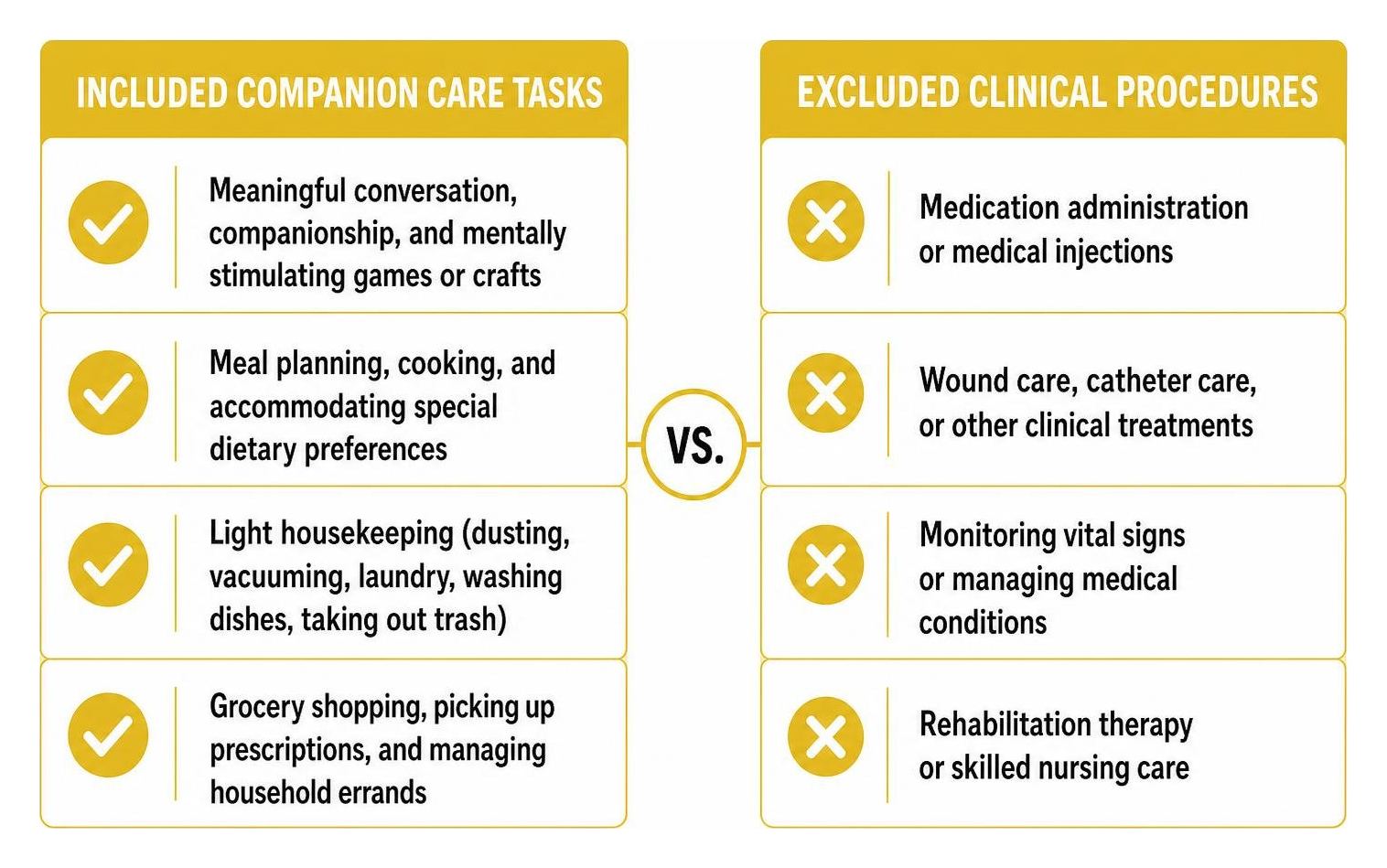
Clear boundaries define non-medical companion care. Knowing what a caregiver can and cannot do protects both your budget and your loved one’s safety:
Typical Included Services:
Meaningful conversation, companionship, and mentally stimulating games or crafts
Meal planning, cooking, and accommodating special dietary preferences
Light housekeeping (dusting, vacuuming, laundry, washing dishes, taking out trash)
Grocery shopping, picking up prescriptions, and managing household errands
Transportation to social outings, church services, and medical appointments
Friendly medication reminders and hydration prompts
Safety oversight to prevent falls and provide peace of mind
Excluded Medical & Hands-On Tasks:
Injections, wound dressing, catheter management, or clinical nursing tasks
Physical physical therapy or occupational rehabilitation
Direct administration of medications (such as measuring prescription dosages)
Intensive, hands-on Activities of Daily Living (ADLs) like full-body bathing, direct toileting care, or mechanical lift transfers (unless upgraded to a personal care plan)
If your family discovers that your loved one's needs are growing beyond friendly visits and light chores, reviewing our guide on in-home help can help you decide when to incorporate hands-on assistance.
Agency Care vs. Direct Hire: Evaluating Cost and Value
When searching for in-home support, families often face a choice: hire an independent caregiver directly through a classified platform or partner with a licensed, managed home care agency.
At first glance, direct hiring appears significantly cheaper. An independent companion might charge $18 to $26 per hour, compared to an agency's $30 to $40 per hour. However, that initial price difference hides substantial legal, logistical, and financial responsibilities that fall entirely on your family:
Feature / Responsibility | Professional In-Home Care Agency | Direct-Hire Independent Caregiver |
|---|---|---|
Hourly Rate | Moderate to Higher ($30–$40/hr) | Lower Base ($18–$26/hr) |
Background Screening & Vetting | Comprehensive national criminal, driving, and reference checks | Family must arrange, conduct, and pay for checks |
Payroll Taxes & Withholdings | Managed entirely by the agency (W-2 employment) | Family is the legal household employer (IRS Form 1040 Schedule H) |
Workers' Comp & Liability Insurance | Fully insured and bonded by the agency | Family assumes personal liability for injuries in the home |
Backup & Respite Coverage | Immediate replacement if regular caregiver is sick or on leave | No automatic backup; family must fill unexpected care gaps |
Specialized Training & Supervision | Ongoing dementia, safety, and caregiving education | Dependent entirely on independent caregiver's initiative |
While direct hiring can work for families with ample free time to manage scheduling, payroll, and emergency backup plans, most families find the peace of mind offered by an established care team well worth the investment.
Key Factors That Alter a Companion Care Price List
Standard rates serve as a baseline, but specific care dynamics often shape final pricing:
Caregiver Experience and Credentials: Highly experienced companions or those holding specialized non-medical certifications may command higher hourly rates.
Weekend and Holiday Premiums: Agencies frequently apply an additional $2 to $6 per hour for weekend shifts or major holidays to incentivize top staff to work non-standard hours.
Specialized Memory Assistance: Providing compassionate care for an individual living with cognitive decline requires patience, redirection techniques, and specific training. Reviewing options for in-home cognitive support ensures you receive qualified assistance tailored to dementia or Alzheimer's needs.
Mileage and Transportation Fees: When companions use their own vehicles to take clients to appointments, grocery stores, or community events, providers generally bill standard IRS mileage rates (or a modest per-trip travel fee) to cover fuel and vehicle wear.
Paying for Companion Care: Insurance, Assistance Programs, and Out-of-Pocket Options
Understanding payment pathways is just as essential as reviewing hourly rates. Because companion care is non-medical, traditional health insurance coverage rules can be confusing for families navigating the process for the first time.

The vast majority of companion care is funded through private pay (out-of-pocket using retirement savings, pension income, home equity, or family contributions). However, several other financial instruments can offset these costs:
Long-Term Care Insurance (LTCI): Traditional health policies exclude non-medical companionship, but comprehensive LTCI policies often reimburse in-home care once a policyholder meets specific benefit triggers (such as needing assistance with instrumental activities of daily living or cognitive impairment supervision).
Medicare Limitations: Traditional Medicare Parts A and B do not pay for non-medical companion care. Medicare only covers short-term, intermittent skilled home health ordered by a physician (like wound care or physical therapy).
Medicare Advantage (Part C): Certain Medicare Advantage plans offer supplemental home-support allowances, though these are typically limited to short respite hours or post-hospitalization recovery windows.
For an exhaustive review of funding mechanics and care pathways, consult our in-home care complete guide for 2026.
Government Programs and Financial Assistance Options
Families seeking additional financial support should look into several state and federal programs designed to help seniors remain comfortably at home:
Medicaid HCBS Waivers: In Utah, Medicaid Home and Community-Based Services (HCBS) waivers (such as the Aging Waiver) help qualified, low-income seniors access non-medical in-home care to delay or prevent nursing home placement. Availability, eligibility, and service caps depend on state appropriations and waiting lists.
VA Aid and Attendance Benefit: Eligible wartime veterans and surviving spouses who require the assistance of another person for everyday safety can receive monthly, tax-free pension enhancements through the Department of Veterans Affairs. This benefit can provide thousands of dollars annually toward in-home care.
Tax Deductibility: In certain situations where companion care is recommended by a physician as part of a formal care plan for a chronically ill or cognitively impaired individual, portions of care expenses may qualify as deductible medical expenses under IRS guidelines.
Local Area Agencies on Aging (AAA): Regional aging resources throughout Utah County offer caregiver respite vouchers, grant programs, and subsidized services to support family caregivers.
To understand how these programs integrate into long-term safety plans, explore our guidance on elderly care at home.
Practical Strategies to Lower Your In-Home Companion Care Expenses
Budgeting for regular in-home support does not have to be an all-or-nothing proposition. Families across communities like Pleasant Grove, Spanish Fork, Highland, and Saratoga Springs use smart scheduling strategies to maximize their care budgets:

Integrate Adult Day Programs: One of the most cost-effective ways to manage companion care costs is pairing in-home visits with adult day center services. Adult day programs offer full days of structured social engagement, activities, and meals at a fraction of the hourly rate of one-on-one in-home care.
Group Essential Tasks into Block Hours: Rather than booking 2 hours every day (which may encounter shift minimums or higher visit rates), schedule two 4-hour blocks per week. Concentrating chores, laundry, meal preparation, and grocery shopping into single, focused visits maximizes caregiver productivity while keeping weekly hours manageable.
Establish a Family-Caregiver Hybrid Schedule: Divide weekly support responsibilities among family members and reserve professional companion care for high-stress times, such as mid-week work afternoons or Saturday mornings.
Avoid Over-Scheduling Early: Start with a modest schedule (e.g., 8 to 12 hours weekly). Observe how your loved one responds before increasing hours, adjusting care intensity as needs naturally evolve.
Frequently Asked Questions About Companion Care Pricing
Does Medicare cover companion care services?
No. Traditional Medicare strictly covers medically necessary, skilled services provided by licensed nurses or physical therapists under a doctor’s order. Routine companionship, homemaking, meal preparation, and personal supervision are considered non-covered custodial care services.
What is the typical minimum shift requirement for companion caregivers?
Most established home care agencies maintain a minimum shift length of 2 to 4 consecutive hours per visit. This policy ensures reliable scheduling for professional caregivers while allowing enough time to complete meaningful household tasks, prepare fresh meals, and engage in quality social activities.
How does companion care compare in cost to adult day care?
While in-home companion care averages $34 per hour for one-on-one attention in the comfort of home, adult day care programs typically charge a flat daily rate between $85 and $140 per day. Combining both options allows families to enjoy personalized in-home help alongside cost-effective group socialization.
Finding the Right Care for Your Family
Choosing companion care is about much more than comparing rates on a pricing sheet—it is about finding compassionate, trustworthy companions who treat your aging loved ones with the dignity and warmth they deserve.
At Aspen Senior Care, we have proudly served families throughout Utah Valley for years, providing award-winning, personalized non-medical caregiving and specialized dementia support. Whether your family lives in Alpine, Cedar Hills, Lindon, Eagle Mountain, Salem, or Payson, our team is dedicated to creating a customized care plan that fits your family's unique routine and budget.
To learn more about our local services, experienced caregivers, and care approach, discover our in-home care philosophy and services today.