
Walking Through the 5 Stages of PD Step by Step
The 5 Stages of Parkinson's Disease at a Glance
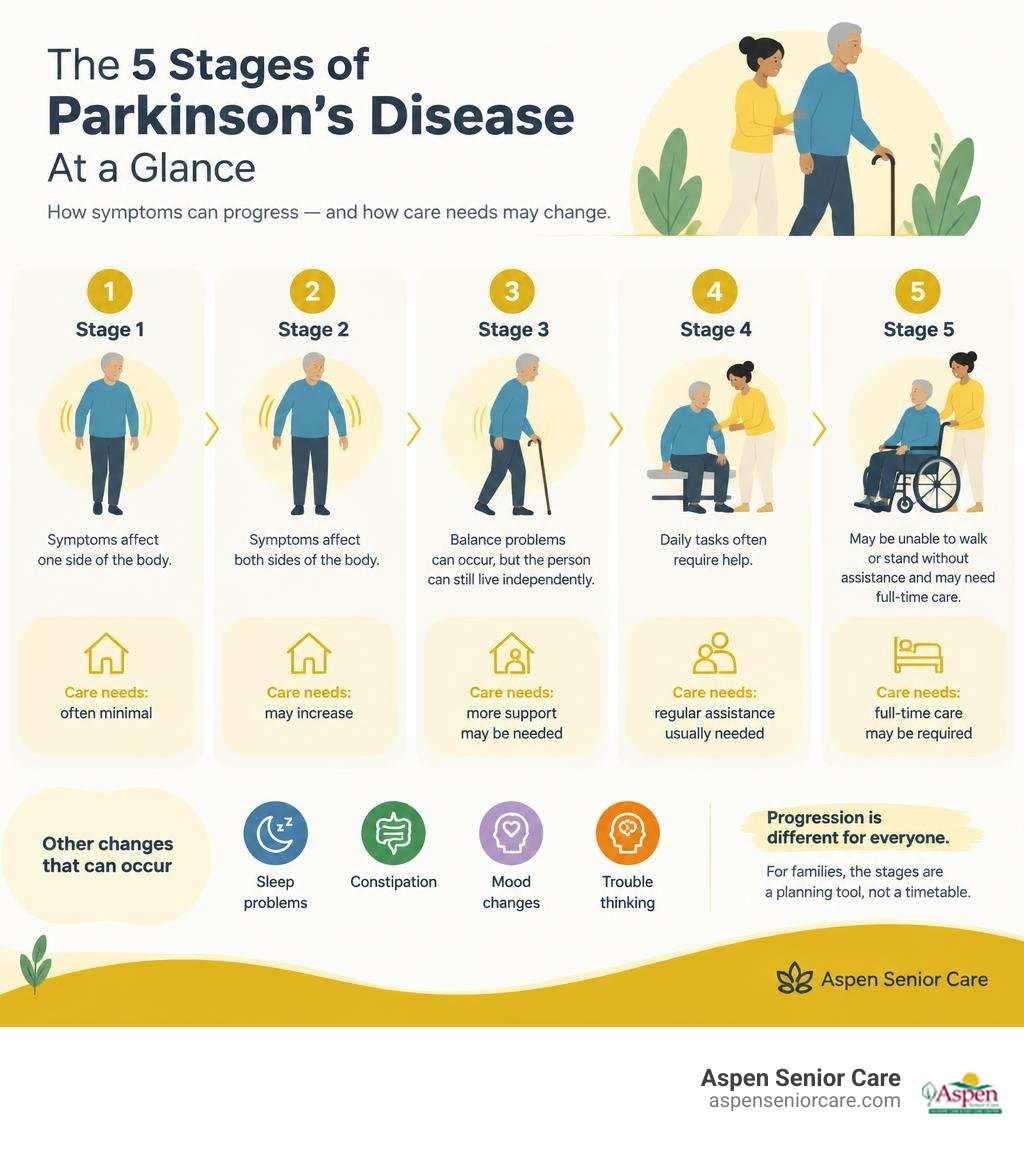
The 5 stages of Parkinson's disease (PD) describe changes in movement and independence. In Stage 1, symptoms affect one side of the body. In Stage 2, they affect both sides. Stage 3 brings balance problems, though the person can still live independently. In Stage 4, daily tasks often require help. In Stage 5, a person may be unable to walk or stand without assistance and may need full-time care.
PD also causes changes that the staging scale does not capture well, including sleep problems, constipation, mood changes, and trouble thinking. Progression is different for everyone. For families helping a parent stay safe at home, the stages are a planning tool, not a timetable.
Understanding the Hoehn and Yahr Staging Scale
When clinicians assess Parkinson’s disease, they rely heavily on standardized systems to evaluate motor impairment and functional disability. The most widely recognized framework is the Hoehn and Yahr scale, introduced in 1967. This clinical assessment tracks how movement symptoms spread across the body and how they impact physical stability.
While modern movement disorder specialists also utilize the Movement Disorder Society-Unified Parkinson’s Disease Rating Scale (MDS-UPDRS) to capture a broader picture of impairment, the classic Hoehn and Yahr framework remains the gold standard for defining broad functional phases. Detailed breakdowns from the Parkinson's Foundation on disease stages highlight that this scale focuses primarily on motor milestones, especially the transition from one-sided symptoms to postural instability.
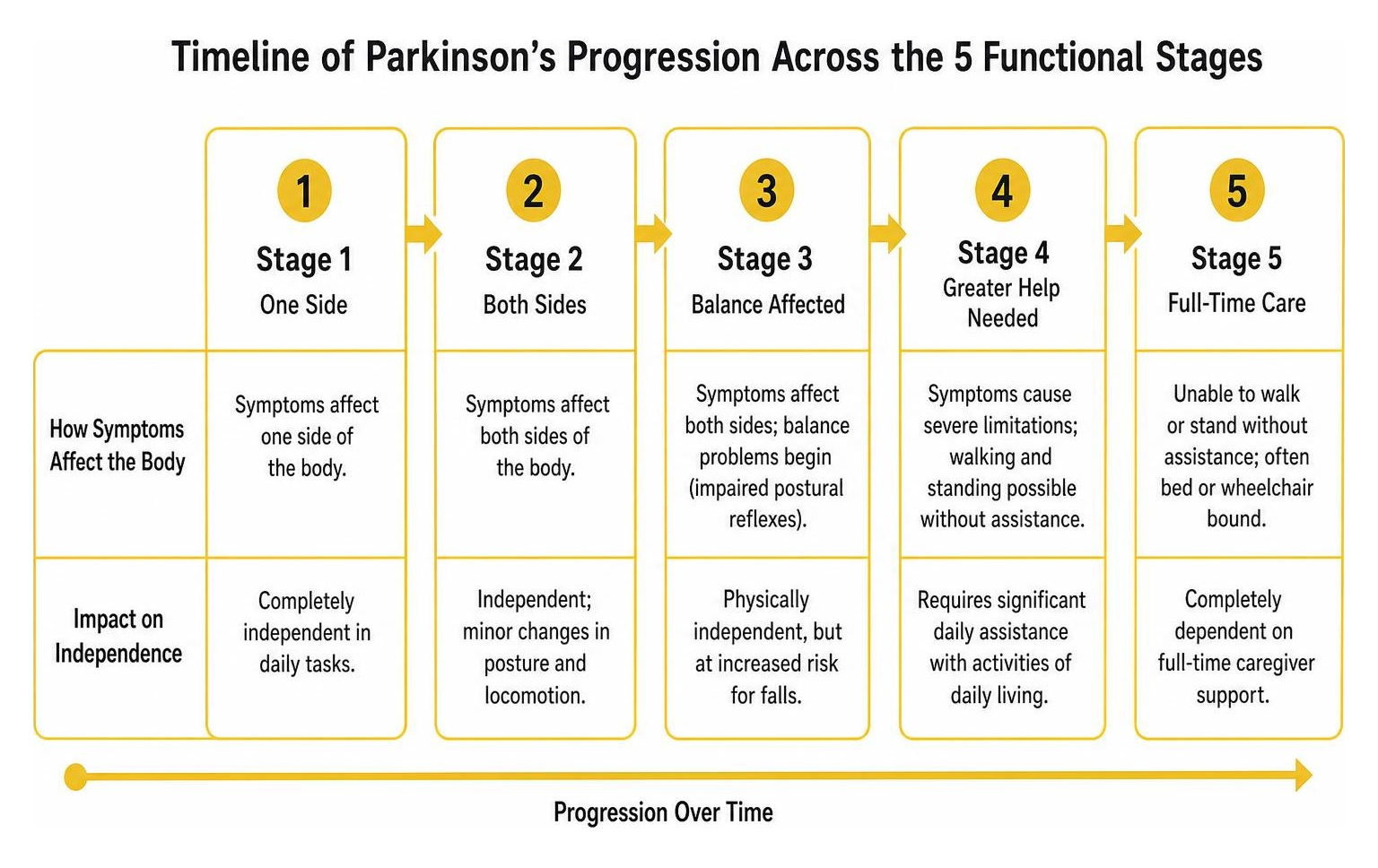
Hoehn and Yahr Stage | Clinical Motor Criteria | Functional Independence Level |
|---|---|---|
Stage 1 | Unilateral involvement only; minimal or no functional disability. | Completely independent in daily tasks. |
Stage 2 | Bilateral or midline involvement without impairment of balance. | Independent; minor changes in posture and locomotion. |
Stage 3 | Bilateral disease; mild to moderate disability with impaired postural reflexes. | Physically independent, but at increased risk for falls. |
Stage 4 | Severely disabling disease; able to walk and stand unassisted but markedly incapacitated. | Requires significant daily assistance with activities of daily living (ADLs). |
Stage 5 | Confinement to bed or wheelchair unless aided. | Completely dependent on full-time caregiver support. |
The 5 Stages of PD: Motor and Non-Motor Progression
Parkinson's is a complex condition that evolves over years. Clinicians and care teams use the American Parkinson Disease Association stage descriptions to help families anticipate emerging physical challenges, ranging from slight tremors to major balance changes.
Early Milestones: Stages 1 and 2
Stage 1: In the earliest clinical phase, motor symptoms appear strictly on one side of the body (unilateral). A person might notice a mild resting tremor in one hand, slight stiffness in one shoulder, or a subtle dragging of one foot. Facial expressions might become slightly less animated on that side, but daily living remains completely independent.
Stage 2: Over time, movement symptoms spread to both sides of the body (bilateral) or affect midline structures. Posture may begin to stoop, and overall stiffness increases. Walking speed often slows, and facial masking (a reduction in spontaneous facial expressions) becomes noticeable. Despite these bilateral changes, reflexes remain intact, meaning balance is preserved and unassisted living is entirely feasible.
Mid-Stage Transition: Stage 3
Stage 3: This stage is considered the true turning point in the progression of Parkinson’s disease. The defining characteristic is the emergence of postural instability—a loss of balance reflexes that leaves individuals vulnerable to falls. While individuals in Stage 3 can still dress, bathe, and walk without physical assistance, bradykinesia (slowness of movement) becomes much more pronounced, making daily routines take significantly longer.
Advanced Disease: Stages 4 and 5
Stage 4: Motor impairment becomes severe and disabling. Although an individual may still be able to stand or walk short distances unassisted, balance is deeply compromised, making a walker or dedicated mobility support essential. Freezing of gait—where the feet feel glued to the floor—often worsens. Daily self-care requires substantial hands-on assistance.
Stage 5: In the final stage, severe rigidity and muscle weakness prevent independent standing or walking. Individuals are typically confined to a wheelchair or bed unless assisted. Round-the-clock physical care becomes necessary to manage mobility, nutrition, and hygiene. Families navigating these advanced changes often look closely at the signs and symptoms of advanced Parkinson's disease to adjust home modifications and caregiving schedules.
Motor vs. Non-Motor Symptoms Across the 5 Stages of PD

While the staging scales focus primarily on motor milestones, non-motor symptoms often create the heaviest daily burden for individuals and families. The underlying loss of dopamine and related neurochemical changes affect systems throughout the entire body:
Sleep Disorders: Sleep disruptions affect up to 75% of patients. Rapid Eye Movement (REM) sleep behavior disorder, where individuals physically act out vivid dreams, often emerges years before motor signs.
Mood Alterations: Depression and anxiety affect up to half of people with Parkinson’s disease, stemming directly from biological brain changes rather than just the psychological stress of diagnosis.
Autonomic Dysfunction: Constipation, orthostatic hypotension (blood pressure drops upon standing), and urinary urgency can emerge early and persist across all five stages.
Sensory Deficits: Anosmia (loss of smell) is frequently one of the earliest signs.
Cognitive Changes: Slower processing speeds, executive functioning challenges, and later hallucinations or dementia can develop as the disease reaches advanced stages.
Factors Influencing Disease Progression and Timelines
No two individuals travel the same road with Parkinson's. Disease trajectory varies widely based on genetic predispositions, overall health, and environmental factors. Modern neuroscience often references Braak’s hypothesis, which proposes that abnormal alpha-synuclein protein aggregates begin accumulating in the olfactory bulb and enteric nervous system (the gut) long before reaching the substantia nigra in the brain.
Proactive lifestyle interventions—such as vigorous cardiovascular exercise, targeted physical therapy, and anti-inflammatory nutrition—have demonstrated substantial benefits in preserving functional mobility. Families creating a comprehensive strategy can consult our Parkinson's care guide for 2026 for actionable lifestyle and home-safety recommendations.
Clinical Progression Rates and Timelines in the 5 Stages of PD
The rate of advancement through the 5 stages of pd varies substantially across the population:
Early Stability: Stages 1 and 2 can last for many years, sometimes spanning a decade or more of manageable symptoms.
Mid-Stage Transition: The transition from Stage 2 to Stage 3 typically occurs 3 to 7 years after initial symptoms and diagnosis.
Advanced Onset: Stages 4 and 5 represent advanced disease that may develop 10 to 20 years after initial diagnosis, though some individuals experience a much slower progression over 20 years or more.
Motor Fluctuations: As dopaminergic medications are used over time, motor fluctuations (the "wearing-off" effect between doses) can become an issue five to 10 years after diagnosis. Postural instability typically emerges around the 10-year mark.
Stage-by-Stage Treatment Strategies and Deep Brain Stimulation
Managing Parkinson's requires adjusting therapeutic tools as physical needs evolve.

In Utah Valley communities such as Orem, Provo, and Lehi, accessing multidisciplinary resources—including movement disorder specialists, physical therapists, and our specialized senior day center support—empowers seniors to maintain active routines and social connection throughout each stage.
Medication Management and Therapy Interventions
Early Stages (1–2): Initial pharmacotherapy often utilizes dopamine agonists, MAO-B inhibitors, or low-dose carbidopa-levodopa to replace or mimic dopamine in the brain. Physical and occupational therapy programs—especially amplitude-based training like LSVT BIG—help maintain stride length and motor confidence.
Mid-Stage (3): As balance shifts, physical therapy focuses on fall prevention, core stability, and gait training. Speech therapy (such as LSVT LOUD) addresses voice softening and early swallowing concerns. COMT inhibitors or extended-release levodopa formulations are often introduced to smooth out medication wearing-off periods.
Advanced Stages (4–5): Treatment pivots toward maximizing comfort, preventing skin breakdown, and utilizing assistive equipment such as specialized walkers, hospital beds, and transfer lifts.
Evaluating Deep Brain Stimulation (DBS)
For individuals struggling with unpredictable medication cycles, Deep Brain Stimulation (DBS) represents a proven surgical intervention. DBS involves implanting electrodes into specific brain regions (such as the subthalamic nucleus or globus pallidus) to deliver electrical impulses that regulate abnormal signals.
Ideal Timing: DBS is most effective when evaluated around Stage 3 or early Stage 4—when patients experience severe motor fluctuations or tremor but still respond well to levodopa and have preserved cognitive function.
Clinical Benefits: DBS plus medications can nearly double the number of "on" hours without dyskinesia each day. The procedure results in a nearly 50% average reduction in medication compared to medical therapy alone.
Tremor Control: DBS can alleviate tremor even if medications do not, with patients reporting up to 80% symptom improvement.
Palliative and Hospice Care for End-Stage Parkinson's
As Parkinson’s progresses into its final stages, the focus of care shifts from aggressive motor optimization to comfort, symptom relief, and dignity. Implementing advance care planning early ensures that a loved one's values and wishes guide every medical decision. For families managing these evolving demands at home, incorporating practical Parkinson's caregiving tips helps prevent caregiver burnout while maintaining safety.
Multidisciplinary Palliative Care Across All Stages
Palliative care is not restricted to end-of-life situations; it is a supportive approach that can be introduced at any stage of Parkinson’s disease. A multidisciplinary palliative team works alongside primary neurologists to manage complex symptoms such as neuropathic pain, gastrointestinal distress, anxiety, and sleep fragmentation, providing an extra layer of emotional and practical support.
When to Transition to Hospice Care
Hospice care becomes appropriate when curative or restorative treatments are no longer the primary goal, and a physician estimates a life expectancy of six months or fewer if the disease runs its natural course. Common indicators for hospice evaluation in Stage 5 Parkinson's include:
Severe dysphagia (swallowing impairment) leading to recurrent aspiration pneumonia or choking risks
Significant, unintentional weight loss and protein-calorie malnutrition
Inability to ambulate, transfer, or maintain head control without full assistance
Profound communication deficits and advanced cognitive decline
Frequent systemic infections or skin breakdown despite attentive daily hygiene
Hospice teams provide comprehensive nursing, pain relief, caregiver respite, and emotional support to ensure comfort during this final chapter.
Frequently Asked Questions About Parkinson's Disease Stages
How fast do individuals progress through the stages of Parkinson's?
Progression timelines vary widely. Some people remain in Stages 1 and 2 for over a decade with mild symptoms, while others see faster transitions. On average, the shift from Stage 2 to Stage 3 takes 3 to 7 years, and advanced stages (4 and 5) typically develop 10 to 20 years after diagnosis.
What is the difference between Stage 2 and Stage 3 Parkinson's?
The defining clinical difference is balance impairment (postural instability). In Stage 2, symptoms affect both sides of the body, but balance reflexes remain intact. In Stage 3, balance reflexes become compromised, causing an increased risk of falls, even though the person remains functionally independent.
Can non-motor symptoms appear before Stage 1 motor signs?
Yes. During what clinicians call the prodromal phase, non-motor symptoms such as loss of smell (anosmia), chronic constipation, REM sleep behavior disorder, and mood changes often appear 5 to 10 years before any noticeable tremor or stiffness emerges.
Conclusion
Understanding the stages of Parkinson’s disease provides families with a roadmap to make informed medical, living, and lifestyle choices. While the disease is progressive, proactive interventions—ranging from early exercise and speech therapy to advanced treatments and in-home care—allow individuals to maintain dignity and meaningful connection.
At Aspen Senior Care, we provide award-winning, family-like in-home caregiving and specialized day programs for families throughout Orem, Provo, Lehi, American Fork, and the greater Utah Valley. Whether your loved one needs companion care during early balance changes or dedicated assistance with advanced mobility, our compassionate team is here 24/7. Explore our guide to understanding Parkinson's disease stages or reach out today to discover how personalized care can support your family's journey.