
Build Balance and Stamina: 30 Minute Workout for Seniors Over 60
Why Functional Exercise Matters After 60
An effective 30-minute workout for seniors over 60 combines four structured phases: a 5-minute dynamic warm-up to lubricate joints, a 12-minute functional strength circuit targeting major muscle groups, an 8-minute balance and core routine to reduce fall risk, and a 5-minute cool-down stretch. Performing this low-impact routine 2 to 3 times per week builds practical stamina and safeguards mobility without overtaxing joints.
Maintaining physical strength as we age is directly tied to our daily independence. Adults naturally lose roughly 3% to 8% of their muscle mass per decade after age 30, and this rate of decline accelerates noticeably after age 60. This natural loss of muscle mass and physical function, known clinically as sarcopenia, can quietly chip away at our ability to complete simple daily activities if we do not actively work against it.
Functional exercise focuses on movements that mirror our daily lives—such as standing up from a low sofa, stepping over an obstacle on the carpet, reaching into an overhead pantry, or carrying a basket of laundry. When we train these patterns, we safeguard our mobility.
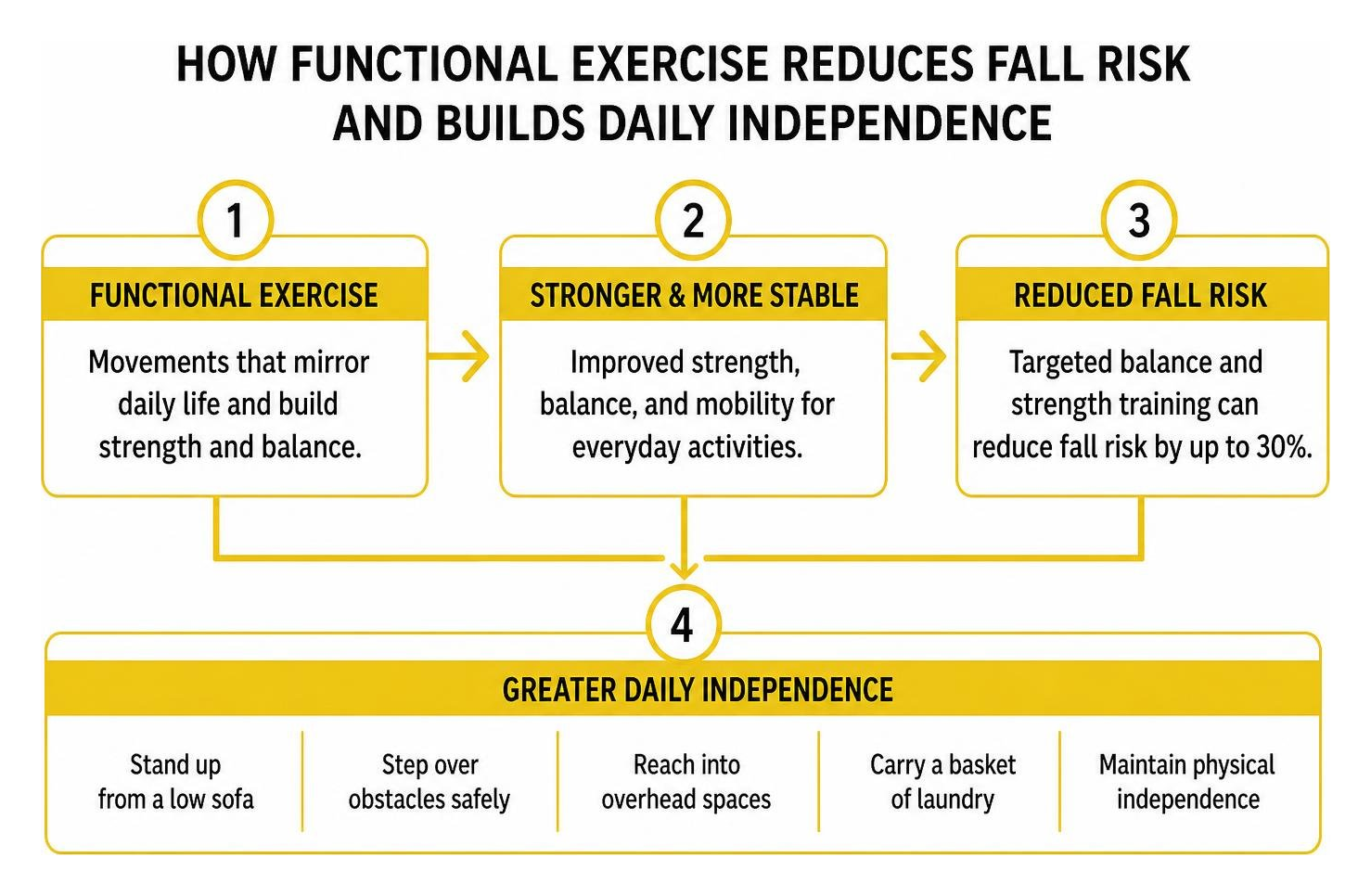
The Centers for Disease Control and Prevention (CDC) and the World Health Organization (WHO) recommend that adults aged 65 and older participate in muscle-strengthening activities at least two days per week, along with regular balance training. These recommendations exist for good reason: targeted balance and strength training can reduce the risk of debilitating falls by up to 30%. Beyond fall prevention, consistent low-impact movement supports joint lubrication, eases arthritic stiffness, improves circulation, and helps maintain healthy resting blood pressure.
Core Benefits of a 30 Minute Workout for Seniors Over 60
Committing to a half-hour session several days a week delivers whole-body benefits that extend far beyond physical muscles:
Enhanced Bone Mineral Density: Resistance exercises place gentle, healthy stress on bones, stimulating mineral retention and slowing osteoporosis.
Sharper Cognitive Function: Physical coordination drills, such as marching holds and cross-body reaching, stimulate neural pathways and support working memory.
Cardiovascular Stamina: Light, continuous movement improves heart health, endurance, and lung capacity, making trips to the store or walks around the neighborhood feel effortless.
Mental Well-Being and Vitality: Physical activity triggers the release of endorphins, reducing feelings of anxiety and improving sleep patterns.
A comprehensive 2023 study published in Medicine & Science in Sports & Exercise demonstrated that engaging in just 20 minutes of daily structured activity produced measurable gains in physical balance, leg strength, and walking speed within six months. Following evidence-based exercise guidelines for older adults ensures that these functional gains translate directly to safety at home.
30-Minute Sessions vs. Longer Gym Workouts
Many people believe that an effective workout requires an hour or more of exhausting effort at a commercial gym. In reality, for adults over 60, longer sessions often lead to excessive joint wear, elevated fatigue, and higher dropout rates.
A well-structured 30-minute functional session delivers an optimal training signal without overburdening the nervous system or joints. It respects energy reserves while building meaningful stamina.
Feature | 30-Minute Functional Home Routine | Traditional 60-Minute Gym Session |
|---|---|---|
Primary Focus | Daily movement patterns, balance, joint stability | Isolated muscle groups, heavy resistance |
Equipment Needed | Sturdy chair, clear wall, light household items | Weight machines, barbells, specialized racks |
Joint Impact | Low-impact, highly customizable | Moderate to high, depending on machinery |
Sustainability | High; easy to do consistently at home | Lower; requires travel, setup, and recovery time |
Injury Risk | Minimal due to controlled bodyweight work | Higher under prolonged physical fatigue |
Essential Preparation and Modifications
Before starting any new exercise routine, set up a safe environment. Clear away throw rugs, loose cords, or clutter that could pose a tripping hazard. Wear supportive, closed-toe athletic shoes with non-slip soles rather than slippers or socks.
Stay well-hydrated by taking small sips of water before, during, and after your session. Practice steady, relaxed breathing throughout each movement; avoid holding your breath, which can cause sudden spikes in blood pressure.
Listen to your body's natural signals. There is a clear difference between normal muscle fatigue (a mild, warm working sensation) and warning signs like sharp joint pain, lightheadedness, or shortness of breath. If you experience acute discomfort, stop immediately. If you have chronic conditions such as heart disease, severe osteoporosis, or vestibular balance disorders, consult your physician before beginning. Families looking for safety advice can explore our caregiver resources for exercise safety to create an ideal home environment.
Equipment and Setup for Your 30 Minute Workout for Seniors Over 60
You do not need an expensive home gym. You can complete an effective total-body routine using simple, sturdy items found around the house.
A Sturdy, Armless Chair: Choose a stable chair with a flat seat that does not roll or swivel.
Clear Wall Space: Useful for supported balance drills and push-ups.
Light Resistance (Optional): A light resistance band, 2-to-3-pound dumbbells, or even two filled 16-ounce water bottles (just ensure the caps are tight!).
Non-Slip Floor Mat: Provides cushioning and traction on hardwood or tile floors.
Adapting Movements for Seated and Low-Mobility Needs
Fitness is never one-size-fits-all. Every exercise in this guide can be adapted to match your personal mobility level, whether standing independently, holding a chair for balance, or remaining seated throughout.
If standing for long periods causes hip or knee discomfort, performing upper-body and core movements from a seated position offers the same cardiovascular and muscular benefits. Using a sturdy chair for seated knee extensions or seated torso twists protects fragile joints while building essential baseline strength. You can explore full-body adaptive movement routines to see how seamlessly seated exercises support functional vitality.
Step-by-Step 30 Minute Workout for Seniors Over 60
This comprehensive workout is divided into four distinct phases. Aim to move at a controlled, deliberate tempo—speed is not the objective; proper posture and stability are.

Phase 1: Dynamic Warm-Up (5 Minutes)
The goal of the warm-up is to elevate your heart rate slightly, lubricate your joints with synovial fluid, and prepare your nervous system for movement. Spend approximately 60 seconds on each exercise:
Seated or Standing March: Gently lift your knees in an alternating marching rhythm while swinging your arms naturally at your sides.
Shoulder Rolls: Draw your shoulders up toward your ears, roll them backward in large circles, and let them drop down. Complete 30 seconds rolling backward, then 30 seconds rolling forward.
Gentle Torso Twists: Sit or stand tall with hands clasped gently at your chest. Slowly rotate your upper torso to the right, return to center, and rotate to the left. Keep your hips facing forward.
Ankle Circles & Point-Flex: While seated or holding a chair, lift one foot off the floor. Rotate the ankle clockwise 5 times, counterclockwise 5 times, then point and flex your toes. Switch to the opposite foot.
Arm Reach & Openers: Inhale as you reach both arms out to the sides to gently stretch your chest, then exhale as you bring them forward to touch palms.
Phase 2: Functional Strength Circuit (12 Minutes)
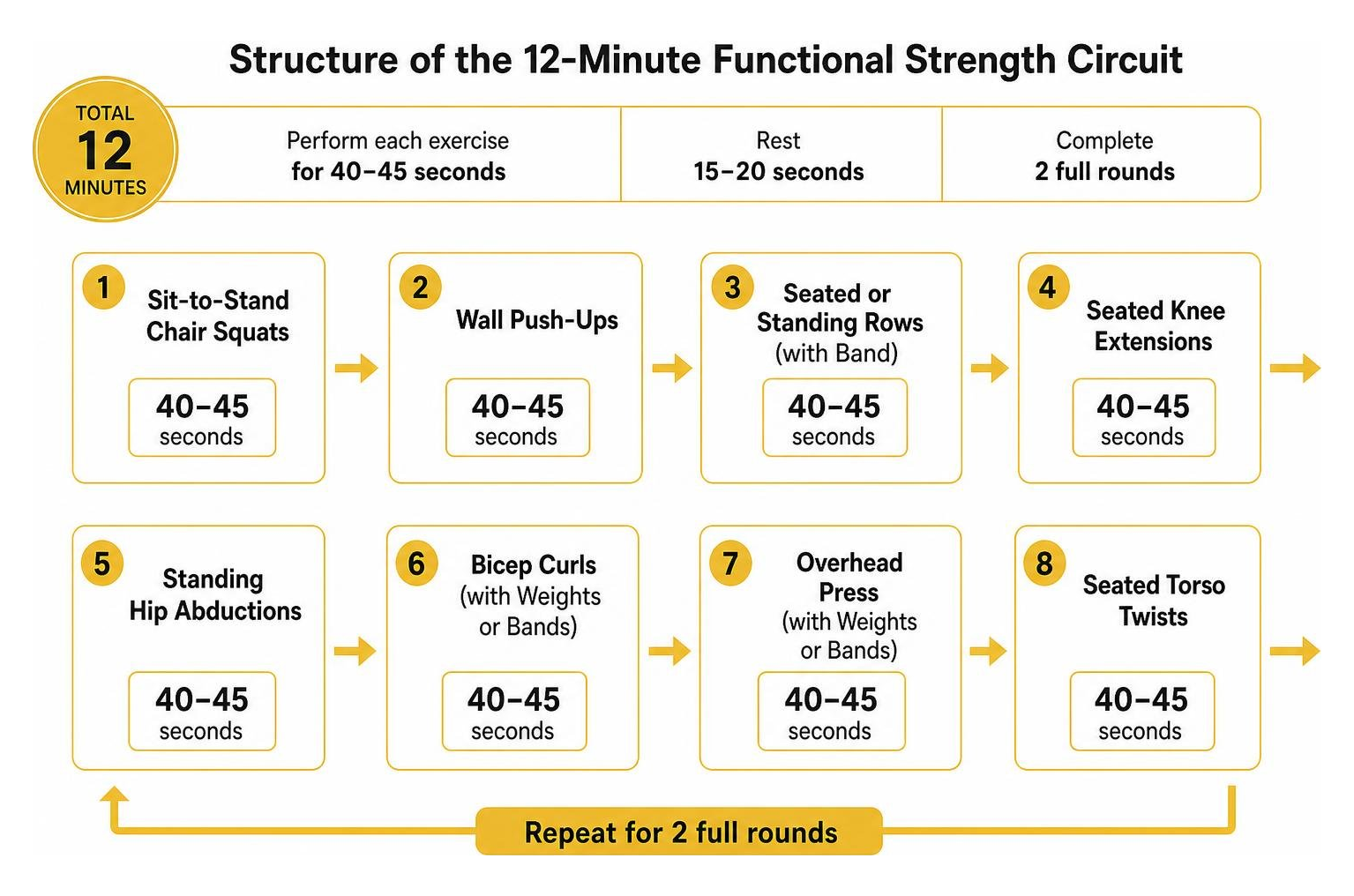
This circuit targets all major muscle groups used in everyday life. Perform each exercise for 40 to 45 seconds, followed by 15 to 20 seconds of rest. Complete two full rounds of the circuit.
1. Sit-to-Stand Chair Squats
Target Area: Quads, glutes, core.
How to Do It: Sit near the front edge of your chair with feet hip-width apart, flat on the floor. Cross your arms over your chest (or use your hands on the chair arms for assistance). Lean slightly forward from the hips, press through your heels, and stand fully upright. Squeeze your glutes at the top, then slowly lower your hips back down onto the chair under control.
Reps: 8–10 controlled repetitions.
2. Wall Push-Ups
Target Area: Chest, shoulders, triceps, core stability.
How to Do It: Stand facing a clear wall, approximately arm's length away. Place your palms flat on the wall at shoulder height and shoulder-width apart. Keeping your body in a straight line from heels to head, bend your elbows to lower your chest toward the wall. Press firmly through your palms to return to the starting position.
Reps: 8–12 reps. (To make it easier, step closer to the wall; to make it more challenging, step further back).
3. Standing or Seated Resistance Rows
Target Area: Upper back, rear shoulders, posture support.
How to Do It: Sit or stand tall with your arms extended straight in front of you at chest height (holding a light band or small water bottles). Pull your elbows back along your sides, squeezing your shoulder blades together as if pinching a pencil between them. Pause for one second, then slowly extend your arms forward.
Reps: 10–12 reps.
4. Heel-to-Toe Calf & Shin Raises
Target Area: Calves, ankles, lower leg stability.
How to Do It: Stand behind your sturdy chair, holding the backrest lightly with both hands. Rise up onto the balls of your feet, lifting your heels as high as comfortable. Lower slowly, then rock back slightly onto your heels to lift your toes off the floor.
Reps: 10–12 reps.
Phase 3: Balance and Core Stability (8 Minutes)
Strong balance prevents falls and gives you confidence on uneven surfaces. Perform each movement for 30 to 45 seconds per side, resting 15 seconds between sets. Complete two rounds.
Single-Leg Stand: Stand next to your chair or a sturdy kitchen counter. Place one hand lightly on the surface. Lift your inside foot two inches off the floor, balancing on your standing leg. Keep your standing knee soft (not locked). Hold for 15 to 20 seconds, then switch sides.
Standing March Holds: Hold onto your support. Lift your right knee up to hip level, pause and hold the balance for 2 to 3 seconds, then lower it down. Alternate to your left leg.
Lateral Leg Raises: Stand tall behind your chair. Keeping your right leg straight and toes pointed forward, slowly raise your right leg out to the side. Avoid leaning your torso to the left. Lower with control. Complete 8 reps per side.
Modified Standing Bird Dog: Stand facing your chair with both hands resting on the backrest. Simultaneously extend your right arm forward and your left leg straight back, tapping your back toe to the floor while bracing your abdomen. Hold for 2 seconds, return, and switch to the opposite arm and leg.
Phase 4: Cool-Down and Flexibility (5 Minutes)
The cool-down allows your heart rate and blood pressure to return to baseline while lengthening working muscles to reduce post-exercise stiffness. Hold each stretch gently for 20 to 30 seconds without bouncing:
Seated Hamstring Stretch: Sit at the front edge of your chair. Extend your right leg straight out with your heel on the floor and toes pointing up. Keeping your back straight, hinge forward gently from your hips until you feel a comfortable stretch along the back of your thigh. Repeat on the left side.
Chest & Shoulder Opener: Sit upright, rest your hands on your lower back or hold the sides of the chair, and gently pull your shoulders back while lifting your chest.
Calf Stretch at the Wall: Place both hands on the wall. Step your right leg straight back, pressing the right heel down into the floor while bending your front left knee slightly.
Deep Diaphragmatic Breathing: Sit comfortably with hands resting on your lap. Inhale slowly through your nose for 4 counts, allowing your belly to expand, then exhale gently through pursed lips for 6 counts. Repeat 4 to 5 times.
How to Build a Sustainable Weekly Exercise Habit
The most effective workout routine is the one you do consistently. Starting with realistic goals creates long-term momentum. A landmark 2022 study in the British Journal of Sports Medicine found that older adults who began with short, manageable exercise commitments were 2.5 times more likely to maintain their routine after six months compared to those who attempted overly intense regimens from day one.
To build a routine that lasts, use these practical habit-building principles:
Habit Stacking: Attach your 30-minute workout to an established daily ritual. For example, exercise right after your morning cup of tea or immediately before your midday lunch.
The "2-for-2" Progression Rule: If you can comfortably complete two extra repetitions on your final set of an exercise for two consecutive workouts without breaking form, you are ready to slightly increase the difficulty (such as slowing down the tempo or adding light resistance).
Track Your Consistency: Place a simple calendar on the refrigerator. Mark an "X" on days you complete your session to visually reinforce your progress.
Common Mistakes to Avoid After 60
Skipping the Warm-Up: Cold tendons and muscles are more susceptible to strains. Never jump straight into strength work without dynamic preparation.
Holding Your Breath (Valsalva Maneuver): Holding your breath during exertion increases intra-thoracic pressure and spikes blood pressure. Breathe out during the hardest part of the movement (the exertion) and breathe in as you reset.
Sacrificing Form for Repetitions: Ten slow, controlled chair squats with proper knee alignment are far safer and more effective than twenty rapid, uncontrolled repetitions.
Ignoring Recovery: Muscles do not grow stronger during exercise—they rebuild and adapt during rest periods. Allow at least 48 hours between strenuous strength sessions for the same muscle groups.
Frequently Asked Questions About Senior Fitness Routines
How often should seniors over 60 perform this 30-minute workout?
For most older adults, performing this full-body routine 2 to 3 non-consecutive days per week (such as Monday, Wednesday, and Friday) provides optimal stimulus for muscle retention, bone health, and balance improvement. On alternate days, engage in light aerobic movement such as walking, swimming, or yard work. If you have questions about structuring daily care and wellness routines for an aging relative, our frequently asked questions about senior wellness care offer helpful guidance.
What should I do if an exercise causes joint discomfort?
Never work through sharp, pinching, or stabbing pain. If an exercise like the sit-to-stand bothers your knees, reduce your range of motion by placing a firm cushion on the chair to raise the seat height. If wall push-ups irritate your shoulders, move your hands closer together and stand closer to the wall to reduce joint loading.
Can I gain muscle and improve balance in my 70s or 80s?
Yes. Multiple clinical studies on individuals in their 80s and 90s demonstrate that the neuromuscular system retains its ability to adapt to resistance training throughout life. Participants consistently achieve meaningful improvements in muscle cross-sectional area, functional stability, and walking speed within 8 to 12 weeks of starting a structured routine.
Conclusion
Building physical stamina and dependable balance after 60 does not require hours in a gym or complicated equipment. By dedicating 30 minutes two to three times a week to functional strength, balance practice, and mobility, you can protect your joints, maintain your stamina, and preserve your independent lifestyle.
At Aspen Senior Care, we work with seniors across Utah Valley—including Orem, Provo, Lehi, American Fork, and Spanish Fork—helping older adults remain active, confident, and socially engaged. Whether through personalized in-home support or our vibrant senior day center, we are dedicated to helping seniors live healthy, fulfilling lives. Choose a comfortable spot at home, set out a sturdy chair, and take your first step toward renewed strength today.